Why Some Gaming Communities Feel Like Home
Jasiah Alvarez
September 9, 2026
Why Some Gaming Communities Feel Like Home
For many people, gaming starts as entertainment. You find a game you enjoy, learn how it works and spend a few hours playing when you have free time. But sometimes something else happens. You begin recognizing the same usernames, joining the same group every evening and talking to people about things that have nothing to do with the game.
Eventually, logging in feels less like starting a piece of software and more like arriving somewhere familiar.
This is why certain gaming communities become so important to the people inside them. They offer shared routines, common interests and spaces where friendships can develop naturally over months or even years. The world may be digital, but the relationships and memories created inside it can be completely real.
The game brings everyone together. The community is often what makes them stay.
Games make meeting people surprisingly natural
Meeting a stranger in ordinary life can involve an awkward question: what are we supposed to talk about?
Games solve that immediately because everyone already has something in common. Players may be trying to win a match, complete a mission, defeat a difficult boss or build something together. They have a shared activity before they know anything about each other.
That removes some of the pressure from social interaction. Conversation can begin with the game and gradually expand into ordinary life. A discussion about strategy turns into a conversation about work. Someone mentions they have an exam tomorrow. Another player talks about a trip they are planning.
Over time, people who originally knew each other only by usernames begin learning about the lives behind those usernames. The friendship develops around the activity rather than needing to be deliberately created.
Familiar usernames start feeling like familiar faces
A strong sense of community usually develops through repetition rather than one dramatic interaction.
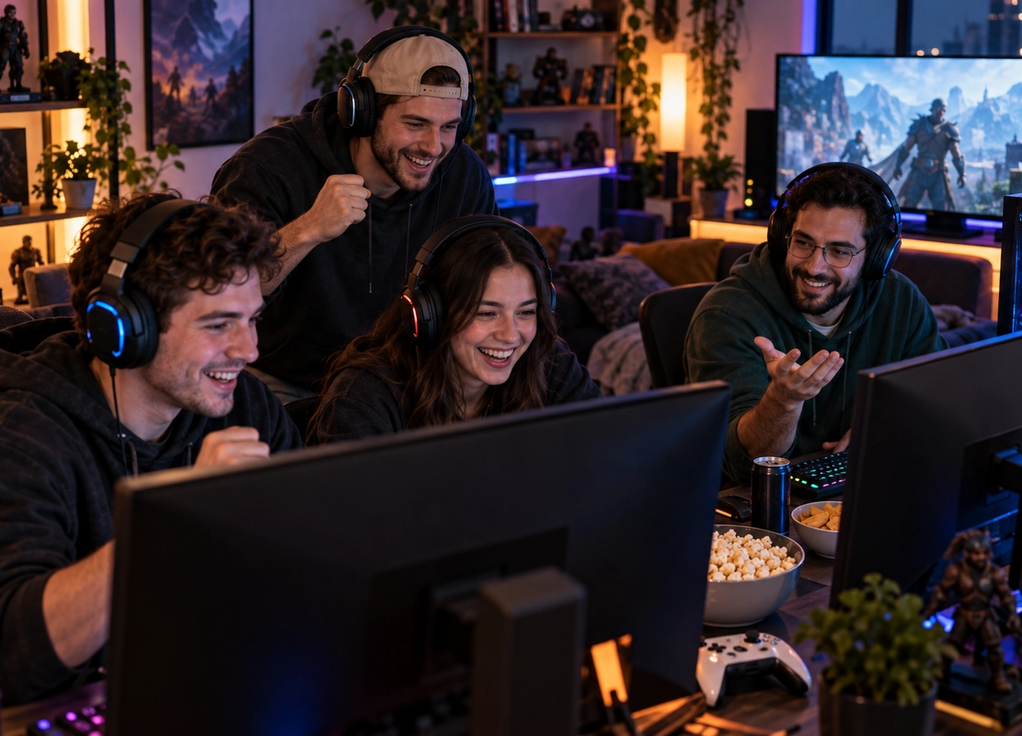
Players return to the same server, guild, clan or group and encounter the same people repeatedly. They begin learning everyone’s habits and personalities. One person always arrives late. Another takes every match far too seriously. Someone else somehow manages to turn every mistake into a joke.
Eventually, people notice when a regular member does not appear.
This familiarity is important because humans build relationships partly through repeated contact. Physical communities work in much the same way. The neighbor you see every morning becomes familiar even before you know them well. The colleague sitting nearby gradually becomes part of your routine.
Gaming communities reproduce that pattern digitally. Instead of recognizing someone’s face across a room, you recognize their username appearing online.
Shared challenges create shared history
Games constantly give players things to overcome together.
A group may spend several evenings trying to complete one difficult mission. A competitive team can lose repeatedly before finally learning how to work together. A survival game might produce a completely unexpected disaster that everyone finds hilarious afterward.
These experiences create stories.
Months later, someone can mention one boss, map or terrible decision and the entire group remembers exactly what happened.
That shared history matters because communities are partly built from collective memory. Families repeat old stories. Friends remember trips and embarrassing moments. Gaming groups remember impossible victories, ridiculous defeats and nights when everyone stayed online much longer than intended.
The setting may be fictional, but the memory of experiencing it together is not.
Every group develops its own language
Long-running gaming groups often develop a vocabulary that would make very little sense to an outsider.
Games already provide specialized terminology through characters, abilities, maps, equipment and strategies. Communities then add another layer through nicknames, running jokes and references to things that happened months or years earlier.
Eventually, one word can remind everyone of an entire story.
This shared language creates a subtle feeling of belonging. Understanding the joke means understanding the group’s history. New members slowly learn the references, while longtime members use them without thinking.
The same phenomenon happens in families, workplaces and close groups of friends. Every established community develops shortcuts that make communication feel uniquely its own.
Gaming communities simply build those traditions inside digital spaces.
The routine can matter as much as the game
For some players, gaming becomes part of the rhythm of everyday life.
Maybe the group meets every Friday evening. Perhaps everyone appears online after work. Some groups organize specific sessions, while others simply know that people will probably be around at roughly the same time.
These routines create something increasingly difficult to maintain in adult friendships: regular contact.
Friends often say they should meet more frequently, but work, family and distance make organizing plans difficult. Gaming provides a simple recurring reason to spend time together.
Nobody has to invent an activity.
They already have one.
Sometimes the group spends the evening intensely focused on the game. Other times, the game becomes background noise while everyone talks.
Either way, people are showing up.
Online friendships can become deeply meaningful
Calling someone an “online friend” can sometimes sound as though the relationship is less important than an offline friendship.
In reality, the distinction is not always useful.
People who play together regularly may speak several times a week or even every day. They hear about jobs, relationships, family problems and important life events. They celebrate good news and notice when someone sounds unusually quiet.
Some gaming friends eventually meet in person. Others live in different countries and may never occupy the same physical room.
That does not automatically determine how close they become.
For people who move frequently or struggle to find others nearby who share their interests, online communities can be especially meaningful. Geography matters less when the same group is available from almost anywhere with an internet connection.
The best communities survive when everyone changes games
A gaming group often begins around one specific title.
Eventually, people get bored.
A new game arrives, the old one changes or members simply stop enjoying it as much as they once did. This can reveal whether the group was really built around the game or around the people.
Strong communities often move together.
They try another game, create a shared chat or continue talking even when nobody is playing anything.
The original game becomes the place where everyone happened to meet.
This is similar to friendships formed at school or work. The institution creates the initial connection, but the relationship can continue long after everyone leaves.
When that happens in gaming, the community has become something larger than the product that created it.
Not every gaming community is welcoming
Gaming communities can also reproduce many of the worst parts of group behavior.
Competitive environments can become hostile. New players may be mocked for making mistakes. Harassment, exclusion and gatekeeping can turn what should be an enjoyable space into an unpleasant one.
The difference between a community that feels welcoming and one that feels exhausting often comes down to culture.
Players establish that culture through the behavior they accept and encourage. Experienced members can help newcomers or make them feel stupid. Group leaders can address toxic behavior or ignore it.
The game provides the environment, but people determine what kind of community develops inside it.
A good gaming community is not automatically created by good game design. It is created when enough people decide that the experience should be enjoyable for the people around them too.
Sometimes you remember the people more than the game
Years later, the details of a favorite game can become surprisingly blurry.
You forget which equipment was best. The ranking system that once seemed incredibly important becomes irrelevant. Newer games make the graphics look old, and servers may eventually shut down entirely.
The people are often easier to remember.
You remember the friend who always joined late, the night everyone finally completed something impossible and the conversations that continued long after anyone was paying much attention to the game.
That is why certain gaming communities can feel like home.
A home is not only a physical location. It can also be a place where your presence is expected, where people know your habits and where returning feels comfortable.
Sometimes that place is a house, a neighborhood or a familiar café.
And sometimes it is a server full of people who notice when you have not logged in for a while.