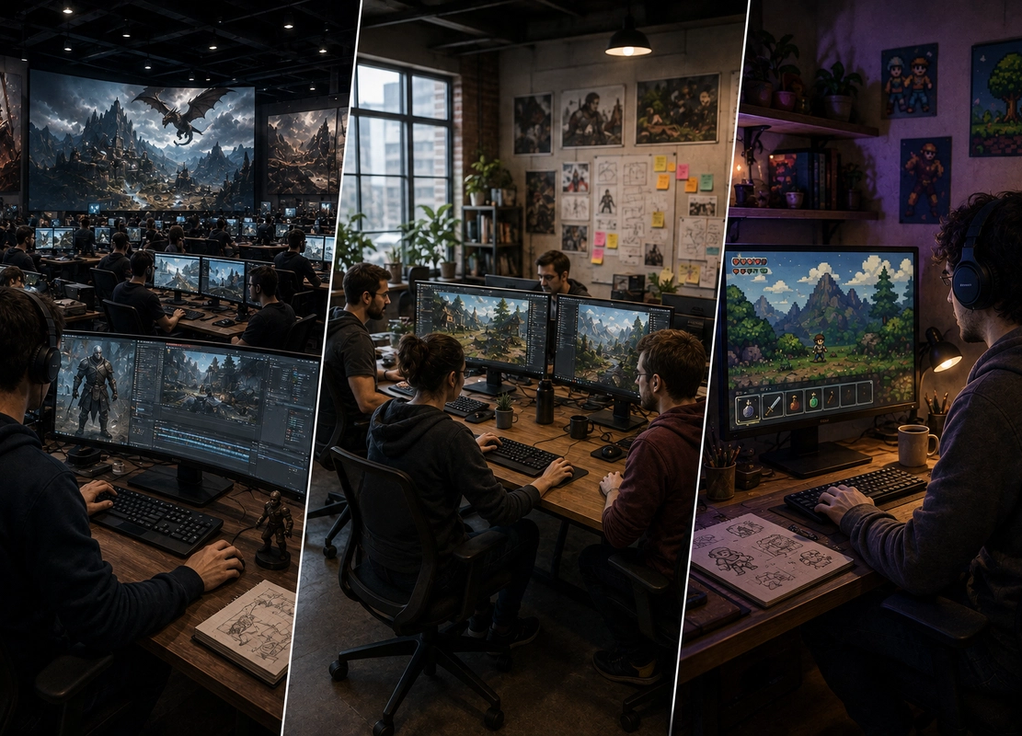
The Difference Between AAA, Indie, and AA Games
Lilian Abbott
September 1, 2026
Video games are often described using labels such as AAA, indie and AA. You might hear that a new AAA game cost hundreds of millions to make, that a small indie title became an unexpected hit or that a new AA release offers something between the two.
These labels can sound like quality ratings, but that is not really what they mean. A AAA game is not automatically better than an indie game, and an indie game is not simply a cheaper version of a major release. The terms mostly describe differences in budget, team size, financing, production scale and creative structure.
The boundaries are also becoming less clear. Some independent studios now create games that look remarkably expensive, while smaller teams owned by large publishers can produce relatively focused projects. Still, understanding the basic categories makes it much easier to understand how different kinds of games get made.
AAA games are the blockbusters of gaming
AAA games are the closest equivalent gaming has to major Hollywood blockbusters. They are typically developed or published by large companies with substantial budgets, large teams and significant marketing campaigns.
These are the games designed to become major global releases.
A modern AAA project can involve hundreds or even thousands of people when external studios, contractors, actors and other contributors are included. Development may take several years, with separate teams responsible for animation, environments, characters, audio, writing, user interfaces, testing and countless other areas.
The result is often enormous in scope. AAA games may offer highly detailed graphics, cinematic storytelling, large open worlds, extensive voice acting and dozens or hundreds of hours of content.
That scale can produce spectacular experiences, but it also creates enormous financial pressure.
Big budgets make AAA games safer and riskier at the same time
Spending huge amounts of money on a game creates an interesting contradiction.
AAA developers can afford technology, talent and production values that smaller studios may struggle to match. At the same time, companies investing that much money usually want some confidence that they will earn it back.
That can encourage safer creative decisions.
Established franchises, familiar genres and proven gameplay systems become attractive because publishers already know an audience exists for them. This helps explain why major gaming companies frequently return to successful series.
A smaller experimental game failing commercially might be disappointing.
A massive AAA project failing can create serious financial consequences for the companies involved.
That does not mean AAA games cannot be innovative. Many are. But innovation happens within a business environment where enormous amounts of money may depend on millions of people buying the final product.
Indie games are defined more by independence than size
“Indie” comes from independent.
Traditionally, an indie game is developed without the same level of financial and organizational support provided by a major publisher. The team may be a small studio or even one person.
This independence can give developers more freedom to experiment.
An indie studio may decide to build a strange puzzle game, tell an unconventional story or use an unusual visual style without needing to convince a huge corporation that the idea can sell millions of copies.
Because budgets are usually smaller, indie developers also have to choose carefully where to spend their resources.
They may use stylized graphics instead of attempting photorealism, focus on a smaller world or build the entire experience around one particularly strong gameplay idea.
Those limitations can become creative strengths.
Indie does not mean amateur
One of the biggest misconceptions is that indie games are somehow less professional than AAA releases.
Some indie games are made by inexperienced developers learning as they go. Others are created by highly experienced teams that deliberately chose to work independently.
Games such as Minecraft, Stardew Valley and Hollow Knight demonstrated how projects created outside the traditional AAA system could attract enormous audiences and influence the wider industry.
An indie game can be polished, commercially successful and technically sophisticated.
The difference is not necessarily the quality of the work.
It is the structure behind the production.
The term has also become more complicated as successful indie studios grow. A company may begin with a tiny team, achieve a major hit and suddenly have the resources to make something far more ambitious.
At that point, deciding exactly where “indie” ends becomes surprisingly difficult.
AA games live somewhere in the middle
AA games are generally understood as productions that sit between indie and AAA.
They often have professional development teams and meaningful budgets but operate on a smaller scale than the industry’s largest releases.
A AA game might have high-quality graphics, full voice acting and sophisticated gameplay while offering a more focused experience than a massive AAA open world.
This middle ground can be creatively interesting.
With less money at risk, developers may have more freedom to explore unusual ideas. At the same time, they can have significantly more resources than a tiny independent team.
Instead of trying to provide everything, a AA game might concentrate on doing a smaller number of things extremely well.
The label itself is informal, however. There is no official budget at which a game suddenly becomes AA rather than indie or AAA.
It is best understood as a useful description of production scale rather than a strict category.
Team size changes how games are made
The difference between these categories is not only visible in the finished product.
It changes the development process itself.
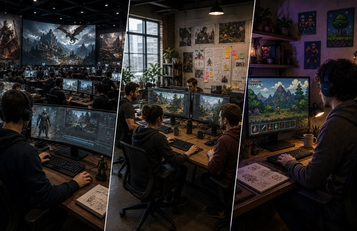
On a tiny indie team, one person might handle several jobs. The programmer may also design levels. The artist might work on animation, marketing materials and the game’s interface.
Communication can be extremely direct because the entire studio may fit into one room or one group chat.
On a AAA project, roles become much more specialized. One developer might spend months working on a particular type of animation or a specific part of the game’s environment.
That specialization allows extraordinary levels of detail, but coordinating hundreds of contributors becomes a major challenge.
Larger does not automatically mean easier.
It often means managing a completely different kind of complexity.
Graphics are one of the easiest differences to notice
AAA budgets are particularly visible in presentation.
Photorealistic characters require detailed models, animation, lighting, performance capture and extensive technical work. Large environments need enormous quantities of art and design.
Smaller studios rarely have the resources to compete directly at that scale.
Instead, many develop distinctive visual identities.
Pixel art, hand-drawn animation, simplified 3D graphics and unusual artistic styles allow smaller games to look memorable without trying to reproduce reality.
This has helped gaming develop an unusually broad visual language.
A game does not need to look realistic to look beautiful.
In fact, some stylized indie games remain visually distinctive long after technically impressive graphics from the same period begin to look dated.
Price does not always reveal the category
It was once easier to assume that expensive games were AAA releases while inexpensive games were indie.
Digital distribution has made that distinction less reliable.
Independent developers can sell directly to global audiences without manufacturing physical copies, while pricing models across the industry have become increasingly varied.
A smaller game can command a premium price if the audience sees enough value in it. AAA games can appear in subscription services or become heavily discounted after launch.
Free-to-play games complicate things further because some of the most expensive games in the world cost nothing to download and earn money through optional purchases.
The price you pay therefore tells you surprisingly little about how much the game cost to create.
None of the labels tells you whether a game is good
AAA, AA and indie are useful terms because they tell you something about the scale and structure of game development.
They do not tell you whether you will enjoy the result.
A AAA game can contain extraordinary technology and still feel uninspired. A game created by three people can become unforgettable. A focused AA release can provide exactly the experience someone wanted without needing the largest possible world or budget.
Each model has advantages.
AAA development can deliver scale and technical spectacle that would be nearly impossible for a tiny team. Indie development can give creators unusual freedom. AA development can combine professional resources with a more focused scope.
The interesting part is that all three can exist on the same console.
One evening you can explore a world built by thousands of people and hundreds of millions in investment. The next, you can play something made by one person in a bedroom.
Both are video games.
They simply took very different roads to reach your screen.