The Weirdest Corners of the Internet You’ve Never Heard Of
Ryker Ware
September 9, 2026
The modern internet can sometimes feel surprisingly small. Most people rotate through the same handful of apps, search engines, streaming platforms and social networks. Algorithms decide what appears next, popular posts travel between platforms, and millions of people end up looking at variations of the same content.
But underneath that polished surface, the internet is still extremely weird.
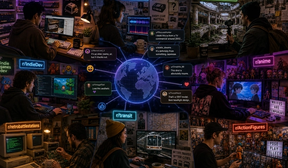
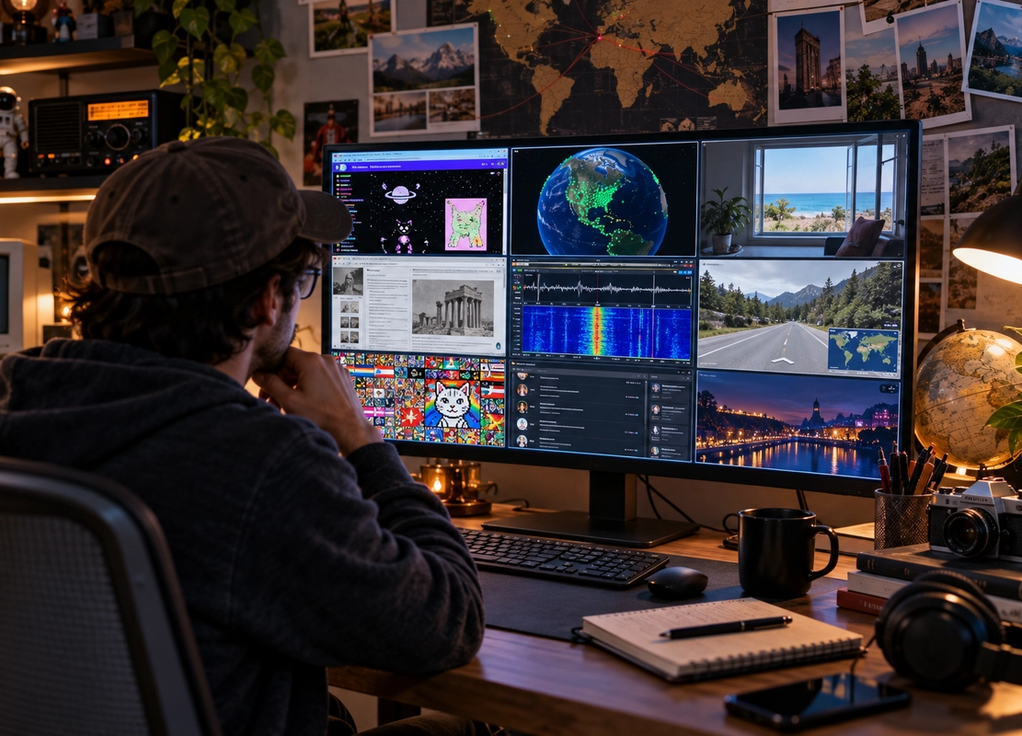
There are communities cataloguing forgotten websites, people communicating through amateur radio networks connected to computers, enormous collaborative art experiments and archives preserving software from machines that disappeared decades ago. Some of these places are old. Others are deliberately designed to recreate the feeling of an internet before everything was organized around feeds and recommendations.
Exploring them can make the web feel enormous again.
Neocities keeps the personal website alive
Before social media profiles became the default way to exist online, people built websites.
They were often messy, colorful and extremely personal. Someone might create a page about their favorite band, another about a video game, and someone else might simply post photographs of their cat beside a blinking animated GIF.
Neocities brings that spirit into the modern web.
The platform allows people to create and host their own websites, and many users deliberately embrace the visual language of the early internet. Pages can contain strange layouts, tiny graphics, guestbooks, personal diaries and collections of links to other independent sites.
There is no requirement that a website become a business, build an audience or satisfy an algorithm.
Sometimes it exists because someone wanted a page dedicated to frogs.
That freedom makes browsing Neocities feel very different from scrolling through a conventional social platform. Every click can move you into a completely different person’s handmade corner of the web.
The Internet Archive contains entire lost digital worlds
The Internet Archive is well known for the Wayback Machine, which allows users to view saved versions of websites from the past.
That alone can become an enormous rabbit hole.
Search for a website you remember from childhood and you may discover versions preserved from 15 or 20 years ago. Logos are different. Links lead to sections that disappeared long ago. Entire companies look frozen at a specific moment in digital history.
But archived websites are only part of the collection.
The Internet Archive also preserves books, audio recordings, videos and software. Some historical computer programs and games can even be explored through emulation.
The experience can feel like digital archaeology.
The internet normally presents itself as permanently new, constantly replacing yesterday with whatever appeared five minutes ago. An archive reveals how much has already vanished.
Radio Garden lets you spin around the planet
Radio Garden turns internet radio into something that feels almost like science fiction.
The interface presents Earth as an interactive globe covered with points representing radio stations. Rotate the planet, select a city and you can listen to broadcasts from that location.
One moment you might be listening to a station in Tokyo.
A few seconds later, you are in Buenos Aires.
Then Reykjavík.
The underlying technology is simply online radio streaming, but presenting it geographically changes the experience completely.
Instead of searching for a particular station, you explore the world through sound.
It also creates a strange reminder that thousands of local conversations are happening simultaneously. News, music, advertisements and talk shows continue everywhere regardless of whether anyone outside that region is listening.
The internet turns all of them into something you can stumble across from your desk.
WindowSwap lets you borrow someone else’s view
One of the internet’s stranger pleasures is discovering a website that does almost nothing but somehow remains fascinating.
WindowSwap is a good example.
People upload videos showing the view from their windows. Visitors can then switch between them, effectively borrowing someone else’s view for a few minutes.
There might be rain falling outside an apartment in Europe, traffic passing through an Asian city or trees moving outside a quiet suburban house.
Nothing particularly dramatic needs to happen.
That is the appeal.
The website creates a tiny form of digital travel built around ordinary life rather than famous landmarks.
It also demonstrates something the internet often forgets: content does not always need to demand attention.
Sometimes watching someone else’s weather is enough.
WebSDR lets you control real radios through a browser
Some corners of the internet feel almost impossible until you understand what they are doing.
WebSDR is one of them.
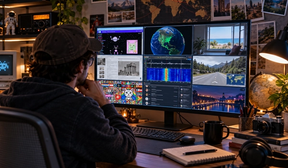
Software-defined radio receivers connected to the internet allow people to tune into radio frequencies through a web browser. Depending on the receiver and location, users can explore amateur radio transmissions and other signals without physically owning the radio equipment themselves.
Suddenly, the invisible electromagnetic activity surrounding the planet becomes something you can investigate.
You encounter voices, digital signals, static and transmissions whose purpose may not be immediately obvious.
For someone unfamiliar with radio, it feels like discovering an entire hidden layer of communication that was always around you.
The interface may look technical and slightly intimidating.
That only makes the rabbit hole better.
GeoGuessr turned random roads into detective puzzles
GeoGuessr is no longer particularly obscure, but the communities surrounding geographic identification have developed into something far stranger than the basic game suggests.
Players are dropped into an image of an unknown location and attempt to determine where they are.
At high levels, people learn to identify countries using details most of us would never notice.
Road markings matter. Utility poles matter. Soil matters. Camera equipment used to capture the imagery can become a clue.
A landscape that looks like “some road somewhere” to an ordinary person can contain dozens of signals to an experienced player.
This has produced an entire culture of visual geography expertise.
People train themselves to recognize the world through tiny differences in infrastructure and landscape.
It is essentially competitive noticing.
Collaborative pixel canvases become tiny civilizations
Large collaborative art experiments have repeatedly demonstrated how quickly internet users organize themselves when given a shared digital space.
One famous example is Reddit’s r/place, where users collectively create images by placing individual pixels onto a giant canvas.
What begins as simple pixel placement quickly becomes territorial politics.
Communities coordinate to build flags, characters, logos and artwork. Alliances form. Images are defended against other groups. Entire sections of the canvas can change within hours.
The interesting part is not simply the finished image.
It is watching thousands of strangers organize themselves with remarkably little centralized control.
A blank digital canvas becomes a temporary map of online communities competing and cooperating in public.
Then the experiment ends, and the entire miniature civilization becomes internet history.
Old forums are digital time capsules
Some of the strangest places online are not experimental websites at all.
They are simply old forums that never disappeared.
You can occasionally find discussion boards with layouts that barely changed since the 2000s. User signatures still contain elaborate graphics. Threads have been active for more than a decade. Members who joined as teenagers are now adults with families.
These spaces feel different from modern social media because conversations are organized around topics rather than recommendation feeds.
A useful thread can remain active for years.
There is also a stronger sense of continuity. Instead of constantly encountering strangers selected by an algorithm, people repeatedly interact with recognizable usernames.
Visiting a long-running forum can feel like walking into a small town that somehow avoided being rebuilt.
The weird internet never actually disappeared
People often say they miss the old internet because it felt more creative, personal and unpredictable.
Some of that is nostalgia.
But some of it reflects a genuine structural change. Much of online life moved from independent websites into enormous platforms where standardized profiles and algorithmic feeds determine how people discover information.
The strange internet still exists.
You simply have to look for it.
Personal websites are still being built. Radio enthusiasts are still connecting receivers to the web. Archivists are preserving forgotten software. Small communities are still maintaining forums that look like they survived several generations of internet design.
These places rarely appear automatically in your feed.
That may be exactly what makes them interesting.
The modern internet constantly tries to predict what you want to see next.
Its weirdest corners remind you how much more fun it can be when nobody has any idea what you are going to find.