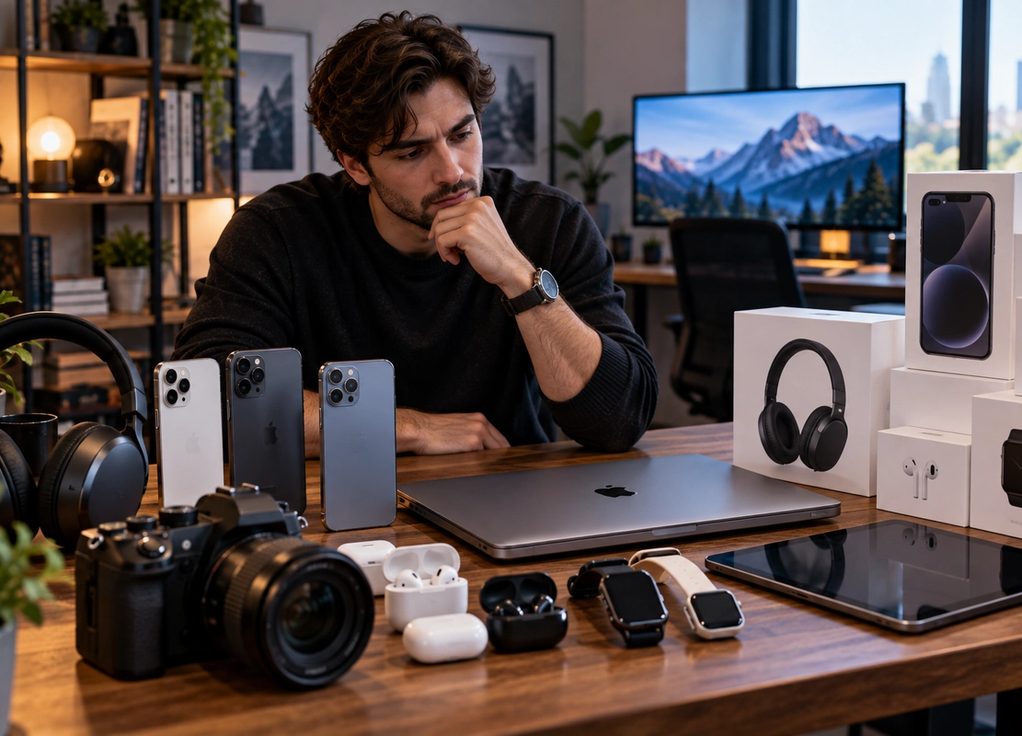
The Hidden Cost of Always Chasing the Newest Gadget
Jayda Gentry
September 9, 2026
There is always something newer coming. A faster phone, a thinner laptop, a smarter watch, better headphones, a television with a sharper display, or a device promising to automate another small part of daily life. Technology companies have become remarkably good at making last year’s perfectly functional gadget suddenly feel old.
Buying new technology is not inherently wasteful. A meaningful upgrade can save time, improve work, make communication easier, or simply be enjoyable. The problem begins when upgrading becomes automatic. If every new release creates the feeling that what we already own is no longer good enough, the cost goes far beyond the number on the receipt.
The upgrade cycle affects our money, attention, expectations, and even the amount of satisfaction we get from technology itself. Sometimes the smartest technological decision is not buying anything at all.
The financial cost is bigger than the price tag
The most obvious cost of constantly upgrading is money, but even that is easy to underestimate. A few hundred dollars here and there can seem manageable, particularly when devices are purchased through monthly payment plans. Over several years, however, frequent upgrades can become a significant recurring expense.
There are also costs surrounding the device itself. A new phone may lead to a new case, screen protector, charger, or set of accessories. A new computer might require adapters, software, storage, or peripherals. One purchase quietly turns into several.
The more useful question is not whether you can afford the newest gadget. It is whether the improvement is worth what you are giving up elsewhere.
Suppose your current phone works well and a new model costs $1,000. Keeping the old phone for another two years does not feel like earning $1,000, but financially the effect can be similar. That money remains available for savings, travel, debt repayment, investments, hobbies, or something you value more.
Small purchasing habits become expensive when they repeat.
New technology creates an attention tax
Every new device requires some amount of mental energy. You have to research it, compare models, choose specifications, order it, set it up, transfer your information, learn new features, adjust settings, and decide what to do with the old device.
None of those tasks is particularly difficult. Together, however, they consume attention.
The same thing happens before the purchase. Product launches encourage comparison. You begin watching reviews, checking specifications, reading comments, and wondering whether a slightly brighter display or faster processor would improve your life.
Technology is supposed to remove friction, but chasing technology can create a different kind of friction. Instead of simply using our tools, we start managing, evaluating, and replacing them.
There is a surprising amount of freedom in deciding that a device is good enough and then forgetting about the market for a while.
Upgrades train us to become dissatisfied
One of the stranger effects of consumer technology is how quickly extraordinary things become ordinary. A phone capable of taking excellent photographs, navigating almost anywhere, making video calls, streaming films, and accessing enormous amounts of information can feel outdated within a few years.
Usually, the device has not become dramatically worse. Our expectations have changed.
Marketing naturally emphasizes the gap between generations. A camera is sharper. A processor is faster. A screen is brighter. A feature that did not exist last year suddenly feels essential.
Once you begin paying close attention to those differences, your existing device can start feeling inadequate even when it still does everything you need.
Then something predictable happens after upgrading: the excitement fades. The new phone becomes simply “my phone.” The new laptop becomes the laptop you open every morning. The satisfaction of owning the latest model is temporary, while the desire for the next upgrade eventually returns.
If novelty itself becomes the goal, there is no final purchase that solves the problem.
The environmental cost happens out of sight
Electronics have physical lives that are easy to forget. Before a device reaches a store, raw materials must be extracted, components manufactured, products assembled, packaged, and transported across complex global supply chains.
And when devices are replaced, they have to go somewhere.
Some are resold or passed to family members, extending their useful life. Others sit unused in drawers. Many eventually become electronic waste. Recycling can recover valuable materials, but electronics are complicated products, and not everything is easily recovered.
This does not mean consumers should feel guilty every time they replace a broken laptop. Technology has a lifespan, and sometimes replacement is the sensible option.
But extending that lifespan even modestly can matter. Keeping a functioning device for four years instead of replacing it after two means fewer devices need to pass through your personal consumption cycle over time.
Repairing a battery, replacing a damaged screen, adding storage, or simply cleaning up an overloaded device may sometimes deliver much of the benefit people are looking for from an upgrade.
Not every upgrade is actually an improvement
Specifications are easy to measure. Better is harder to define.
A new laptop may be dramatically faster on paper, but if you mostly write documents, browse the web, and watch videos, you may barely notice. A new phone camera might perform better in difficult lighting, but that difference matters little if photography is not important to you.
The most useful question before upgrading is simple: What problem will the new device solve?
If you can answer immediately, the purchase may make sense. Perhaps your battery no longer lasts through the day, your computer cannot handle the software required for your work, or a new feature would genuinely save you hours every week.
If the answer is mostly “because there is a newer one,” waiting is usually worth considering.
Make technology prove that it deserves replacing
A healthier relationship with gadgets does not require rejecting new technology. It means making upgrades intentional rather than automatic.
Instead of replacing devices according to release cycles, replace them according to usefulness. Keep a phone until battery life, performance, security support, storage, or another meaningful limitation begins interfering with how you use it. Upgrade a computer when your actual workload demands more capability, not simply because a faster processor exists.
You can still enjoy technology. You can follow product launches, appreciate clever engineering, and occasionally buy something simply because it brings you joy.
The difference is remembering that newness and usefulness are not the same thing.
The best gadget is not always the newest one. Often, it is the one you already own, know how to use, and do not have to think about.