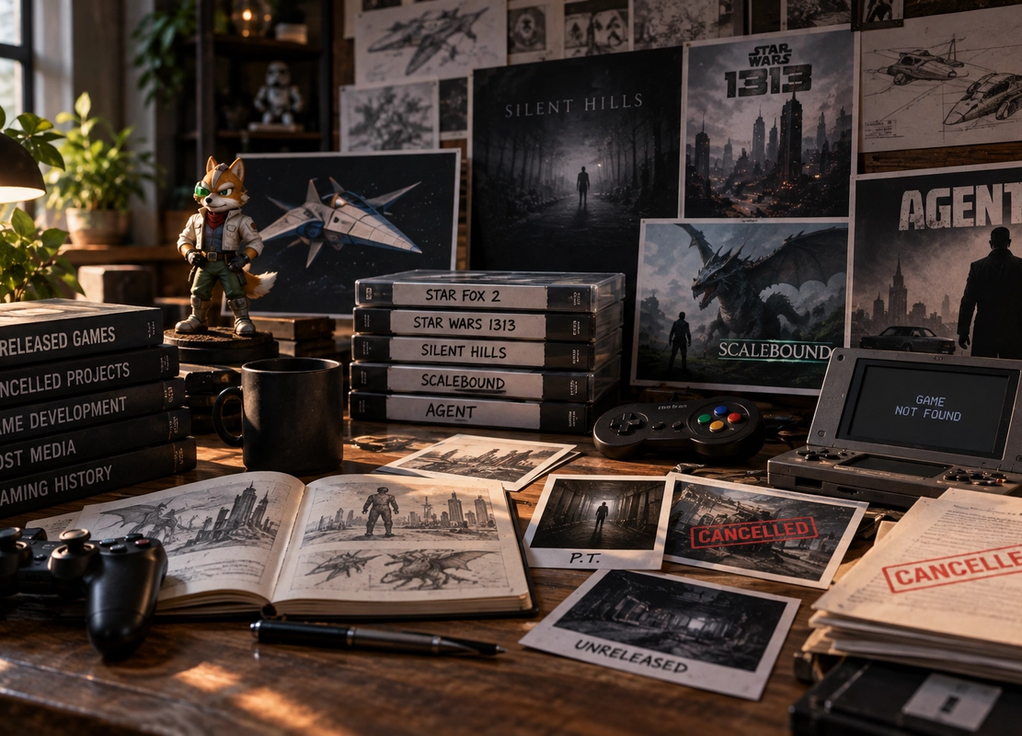
The Strange Story of Video Games That Were Never Released
Ryker Ware
September 11, 2026
Making a video game can take years, involve hundreds of people and cost millions of dollars. You might assume that once a project reaches a certain point, releasing it is inevitable.
Gaming history says otherwise.
Entire games have been designed, programmed, demonstrated to journalists and advertised to players before disappearing. Some were cancelled because development became too expensive. Others were caught in corporate changes, technical problems or disagreements between companies. A few became legendary precisely because nobody could officially play them.
These cancelled games occupy a strange place in gaming culture. Unlike a bad game, they can never be judged properly. Players are left with screenshots, trailers, leaked prototypes and stories from developers, creating imaginary versions of what the finished games might have become.
Star Fox 2 was finished and then disappeared
Star Fox 2 is one of the strangest examples because Nintendo essentially completed the game for the Super Nintendo and then chose not to release it.
Developed in the 1990s, the sequel expanded considerably on the original Star Fox. It introduced new characters, more freedom of movement and gameplay ideas that would later appear in other entries in the series.
The problem was timing.
As development continued, the gaming industry was moving toward a new generation of 3D hardware. Nintendo was preparing the Nintendo 64, and releasing an ambitious Super Nintendo 3D game risked looking outdated next to newer technology.
So Star Fox 2 was shelved.
For years, it became one of gaming’s famous lost titles, circulating through unfinished versions and fan discussion.
Then something extremely unusual happened.
Nintendo officially released the completed game more than two decades later as part of the Super NES Classic Edition in 2017.
A cancelled game had effectively returned from the dead.
Star Wars 1313 vanished during a corporate earthquake
When Star Wars 1313 was revealed in 2012, it immediately attracted attention.
The game promised a darker, more mature journey through the criminal underworld of Coruscant. Instead of focusing primarily on Jedi powers, it emphasized bounty hunters, weapons and cinematic action.
Footage looked polished enough that players could easily imagine the finished product.
Then the business surrounding it changed.
Disney acquired Lucasfilm in 2012 and later shut down LucasArts as an internal game-development studio. Development of Star Wars 1313 stopped, and the project was ultimately abandoned.
That cancellation became particularly painful for fans because the game had already established such a clear identity publicly.
It was not merely a title mentioned in a corporate document.
People had seen it.
They could imagine playing it.
That makes cancellation feel very different.
Silent Hills became famous through a game that was not technically the game
In 2014, PlayStation users discovered a mysterious free game called P.T.
It appeared to be a small first-person horror experience built around repeatedly walking through the same terrifying hallway.
Eventually, players discovered its real purpose.
P.T. stood for “Playable Teaser,” and completing it revealed that it was announcing Silent Hills, a new entry in Konami’s horror series involving Hideo Kojima, filmmaker Guillermo del Toro and actor Norman Reedus.
The combination generated enormous excitement.
Then the project collapsed amid changes in the relationship between Kojima and Konami.
Silent Hills was cancelled in 2015, and P.T. was removed from the PlayStation Store.
The result was bizarre: the advertisement for the game became one of the most influential horror experiences of its era, while the actual game never existed as a finished release.
Years later, developers continued borrowing ideas from P.T.
The teaser outlived the product it was created to promote.
Scalebound disappeared after years of publicity
Microsoft announced Scalebound in 2014 as an Xbox One project from PlatinumGames.
The premise was difficult to ignore.
Players would control a young man fighting alongside an enormous dragon, combining action combat with a partnership between the two characters.
The game appeared at major industry events and received extensive coverage.
Then, in early 2017, Microsoft announced that development had ended.
The cancellation demonstrated how little public visibility guarantees.
A game can have trailers, gameplay demonstrations and years of promotion while still facing serious development problems behind the scenes.
Players see carefully selected pieces of a project.
They rarely see how difficult it is to turn those pieces into a complete game that works consistently from beginning to end.
Agent became a Rockstar mystery
Few cancelled games generated as much speculation from so little public material as Agent.
Rockstar Games announced the PlayStation 3 title as an espionage game set during the Cold War. Given Rockstar’s success with Grand Theft Auto, expectations were immediately enormous.
Then very little happened.
Years passed without a release.
The game remained associated with occasional corporate references, trademark discussions and speculation about whether development was still happening.
Eventually, it became clear that Agent was unlikely ever to appear.
The mystery itself became part of the game’s identity.
Players knew just enough to imagine what a Cold War espionage game from Rockstar might have been, but not enough to know whether the actual project could ever have matched those expectations.
Sometimes a cancelled game becomes more interesting because so little of it survives.
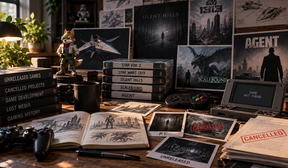
Cancelled games can survive through prototypes
A game does not always disappear completely when development stops.
Studios create prototypes, demonstration builds and internal versions throughout production. Occasionally, those materials escape into the public.
Collectors and preservation communities have recovered unfinished games through development cartridges, old computer files and hardware once used by developers.
These discoveries can be historically important.
A prototype reveals how developers were experimenting with technology and design at a particular moment. It can show features that were removed, ideas that later appeared elsewhere or entire directions a franchise might have taken.
Playing an unfinished game is also a reminder that development is a process.
Textures may be missing. Levels can abruptly end. Menus barely work. Characters behave strangely.
You are not playing a product.
You are looking inside the workshop.
Games get cancelled for surprisingly ordinary reasons
Fans sometimes imagine that cancelled games must have spectacular stories behind them.
Often, the explanation is much less dramatic.
Games are expensive projects operating inside businesses.
A publisher can decide that expected sales no longer justify the development cost. A studio can close. A licensing agreement can change. Technology can become outdated before the project is ready.
Sometimes the game simply is not becoming good enough.
This last possibility is easy to forget because promotional footage presents the strongest parts of a project.
A five-minute demonstration can look incredible while the remaining 20 hours barely function.
Cancelling years of work is painful, but continuing to spend money does not automatically solve fundamental problems.
Sometimes stopping is the least bad option.
Cancelled games become perfect in people’s imaginations
An unreleased game has one enormous advantage over a released one.
Nobody can prove it was disappointing.
Players can imagine the ideal version based on trailers, screenshots and developer interviews. Missing details are filled with possibility.
A released game has loading times, bugs, repetitive missions and design choices people dislike.
A cancelled game has potential.
This can transform unfinished projects into legends.
Silent Hills might have revolutionized horror. Star Wars 1313 might have become one of the greatest Star Wars games. Agent might have created an unforgettable Cold War world.
Or perhaps none of them would have worked.
We cannot know.
That uncertainty is exactly what keeps people talking about them.
Unreleased games are part of gaming history too
Gaming history is usually told through the products that reached store shelves.
But the games that disappeared can be just as revealing.
They show abandoned ideas, changing technologies and the enormous uncertainty behind creative development. They also remind us that the polished game on a screen is only the final survivor of a much messier process.
For every famous release, developers experimented with concepts that were rewritten, reduced or completely abandoned.
Most disappear quietly.
A few leave behind enough evidence to become legends.
And every time an old prototype, screenshot or forgotten development build appears online, players get another glimpse of an alternate gaming history: one filled with games that almost existed.