The Video Games That Defined Every Generation
Luna Giles
September 1, 2026
Every generation of gaming has a handful of titles that become bigger than the machines they were made for. You do not necessarily need to have played them to recognize their characters, music or influence. They introduced ideas that other developers copied, changed what players expected from games and, in some cases, became permanent parts of popular culture.
Choosing one game to represent an entire era is almost impossible because gaming generations overlap and different players experienced them differently. Someone who grew up with a PC may remember a completely different set of defining games from someone who owned a Nintendo or PlayStation console. Still, certain titles clearly marked turning points in how games looked, played and connected people.
Looking across gaming history reveals something more interesting than a list of classics. It shows how video games evolved from simple arcade challenges into enormous interactive worlds and social spaces used by millions of people.
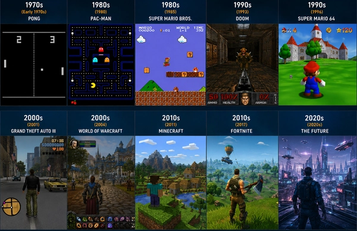
Pong showed that video games could become entertainment
By modern standards, Pong could hardly be simpler. Released by Atari in the early 1970s, the game presented two paddles hitting a square “ball” back and forth across a screen. There were no characters, elaborate environments or complicated controls.
Its importance came from what it demonstrated. Electronic games could be immediately understandable, competitive and entertaining enough that people would pay to play them. Pong became an early commercial success and helped establish video games as a viable entertainment business.
It also established an idea that would remain central to gaming: technology did not need to be complicated if the interaction itself was satisfying. Two people could understand the objective almost instantly and start competing.
That social simplicity helped turn video games from technological experiments into something ordinary people wanted to play.
Pac-Man gave gaming one of its first global characters
Early arcade games were often built around spaceships, sports or abstract shapes. Pac-Man felt different. Released in 1980, it gave players a recognizable character moving through a colorful maze while being chased by ghosts with distinct personalities.
Pac-Man became much more than a successful arcade machine. The character appeared on merchandise, television and countless other products, helping demonstrate that video games could produce cultural icons in the same way films and cartoons could.
The game also appealed beyond the audience associated with early shooting games. Its rules were simple enough for almost anyone to understand, but achieving high scores required genuine skill.
Decades later, the yellow character remains recognizable even to people who have never stood in front of a Pac-Man arcade cabinet.
Super Mario Bros. helped define the home console
When Super Mario Bros. arrived on the Nintendo Entertainment System in the 1980s, it helped establish a template for side-scrolling platform games and became closely associated with the revival and expansion of home console gaming.
Its world was colorful, readable and full of secrets. Running and jumping felt simple, but players gradually learned how momentum, enemies, platforms and hidden areas worked together.
Mario himself became the face of Nintendo and eventually one of the most recognizable fictional characters in the world.
The game’s influence can still be seen in modern platformers. More importantly, it helped establish the idea that a home console could offer carefully designed experiences worth returning to repeatedly rather than merely providing simplified versions of arcade games.
For millions of players, Mario became synonymous with video games themselves.
Doom changed how action games felt
The early 1990s brought increasingly capable home computers, and Doom demonstrated what that additional power could do.
Its fast first-person action felt dramatically different from many earlier games. Players moved through environments from the character’s perspective, fighting enemies and navigating maze-like levels at a speed that made the game feel immediate and intense.
Doom also became important because of how it spread. Its distribution model allowed part of the game to circulate widely, while players created modifications and custom levels.
That culture of sharing and modifying games helped establish ideas that remain important in PC gaming today.
The first-person shooter genre existed before Doom, but Doom became one of the games that defined it. Generations of later shooters inherited ideas from the foundations it helped popularize.
Super Mario 64 taught players how to move in 3D
Moving from two-dimensional games into three-dimensional environments created an enormous design challenge. Developers had to rethink cameras, controls, level design and the basic way players understood space.
Super Mario 64 became one of the defining answers.
Released for the Nintendo 64 in 1996, it allowed players to run freely through 3D environments with a degree of movement that felt remarkable at the time. The analog stick made speed and direction more precise, while the camera system attempted to give players a useful view of the action.
Many things modern players take for granted had to be invented or refined during this era.
Super Mario 64 helped establish a language for 3D games that later developers could build upon.
Grand Theft Auto III made open worlds feel alive
Open-world concepts existed before Grand Theft Auto III, but its 2001 release changed expectations about what those worlds could be.
Liberty City felt like a place rather than simply a collection of levels. Players could follow the story, drive around, explore or ignore their objectives for a while and create their own entertainment.
That freedom became enormously influential.
Many later games adopted the idea of giving players large environments filled with missions, side activities and systems that could interact in unexpected ways.
Grand Theft Auto III also helped push gaming toward a more cinematic style, combining voice acting, music, storytelling and an explorable 3D city.
Its influence can be seen across countless open-world games that followed.
World of Warcraft turned games into places people lived
When World of Warcraft launched in 2004, online games already existed, but its scale and accessibility helped bring massively multiplayer online gaming to an enormous audience.
Players did not simply complete the game and leave.
They created characters, joined guilds, formed friendships and returned to the same world for months or years. The social relationships surrounding the game became as important as many of its quests.
World of Warcraft demonstrated that a video game could function almost like a persistent social place.
For some players, logging in was less like starting a traditional game and more like visiting somewhere their friends happened to be.
That idea would become increasingly important as online connectivity transformed gaming.
Minecraft made creation as important as winning
Minecraft looked almost deliberately old-fashioned when it became popular. Its world was made from blocks, its graphics were simple and there was no traditional cinematic storyline telling players exactly what to do.
That openness became its greatest strength.
Players could explore, survive, build enormous structures or invent their own objectives. Children and adults could approach the same game in completely different ways.
Minecraft also arrived at the perfect moment for online video. Creations, tutorials, challenges and multiplayer adventures generated an almost unlimited amount of content for YouTube and later platforms.
Instead of simply consuming what developers had created, players became creators themselves.
Minecraft eventually became one of the clearest examples of a game becoming a platform for imagination rather than a fixed experience.
Fortnite blurred the line between game and social platform
Fortnite’s battle royale mode became a global phenomenon, but its influence went beyond its basic gameplay.
The game became a place where people met friends, watched virtual events, encountered entertainment franchises and participated in constantly changing seasons.
Its free-to-play model also showed how enormous games could build audiences without requiring an upfront purchase, while cosmetic items and seasonal passes supported the business behind them.
Fortnite reflected a broader change in gaming. For younger players especially, games were becoming social spaces rather than products that were simply completed.
You did not necessarily ask whether someone had “finished” Fortnite.
You asked whether they were getting online tonight.
The defining game of a generation changes what comes next
The games that define generations are not always the ones with the best graphics or even the highest sales. They are the games that change expectations.
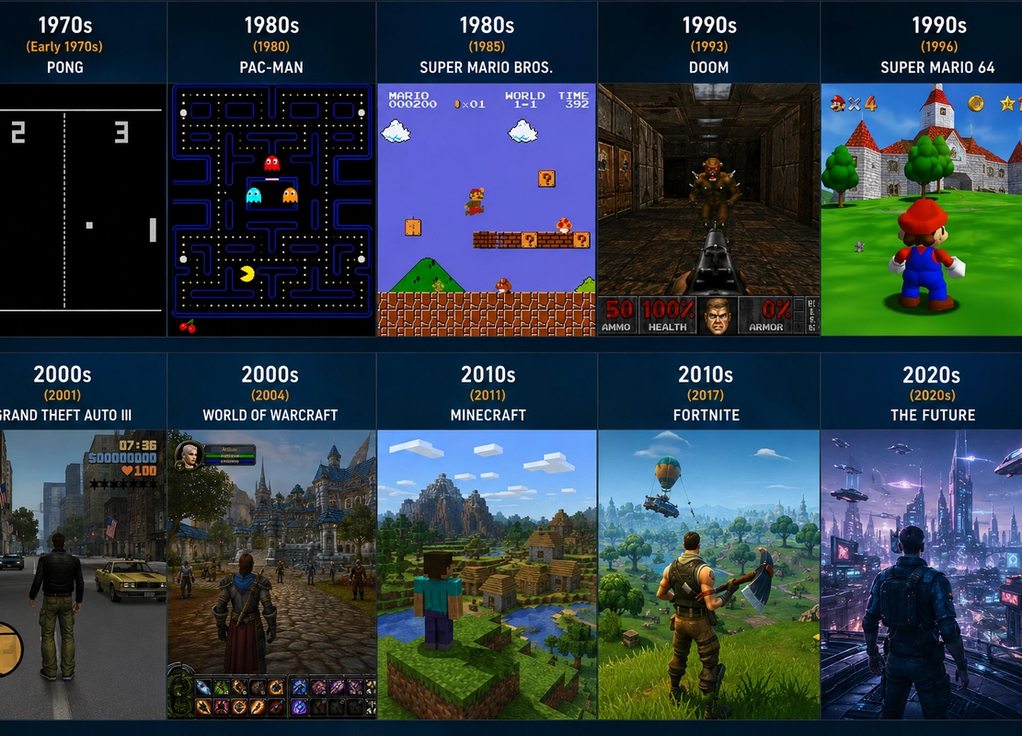
Pong demonstrated that electronic games could become mass entertainment. Pac-Man showed that games could create cultural characters. Mario helped define both 2D and later 3D platforming. Doom transformed first-person action. Grand Theft Auto III expanded the possibilities of open worlds. World of Warcraft made persistent online worlds mainstream, while Minecraft and Fortnite showed how games could become creative and social platforms.
Future generations will have their own defining titles, and they may look very different from what we currently call video games.
That is what makes gaming history interesting.
Each generation inherits ideas that once seemed revolutionary, treats them as completely normal and then builds something new on top of them.