The Sci-Fi Movies That Predicted Real Technology
Luna Giles
September 1, 2026
Science fiction has always been good at imagining impossible machines. Flying cars fill futuristic cities, robots behave like humans and computers seem to understand every word people say. Most of those inventions remain fiction, but every so often, an old science-fiction movie contains a piece of technology that looks surprisingly familiar today.
That does not necessarily mean filmmakers accurately predicted the future. Writers often imagined technologies that researchers were already experimenting with, and engineers who grew up watching science fiction sometimes later helped create similar products. What makes these films fascinating is how accurately some of them understood what people might eventually want technology to do.
From video calls to artificial intelligence, several technologies that once communicated “the future” on screen have quietly become ordinary parts of real life.
2001: A Space Odyssey imagined the screen-filled future
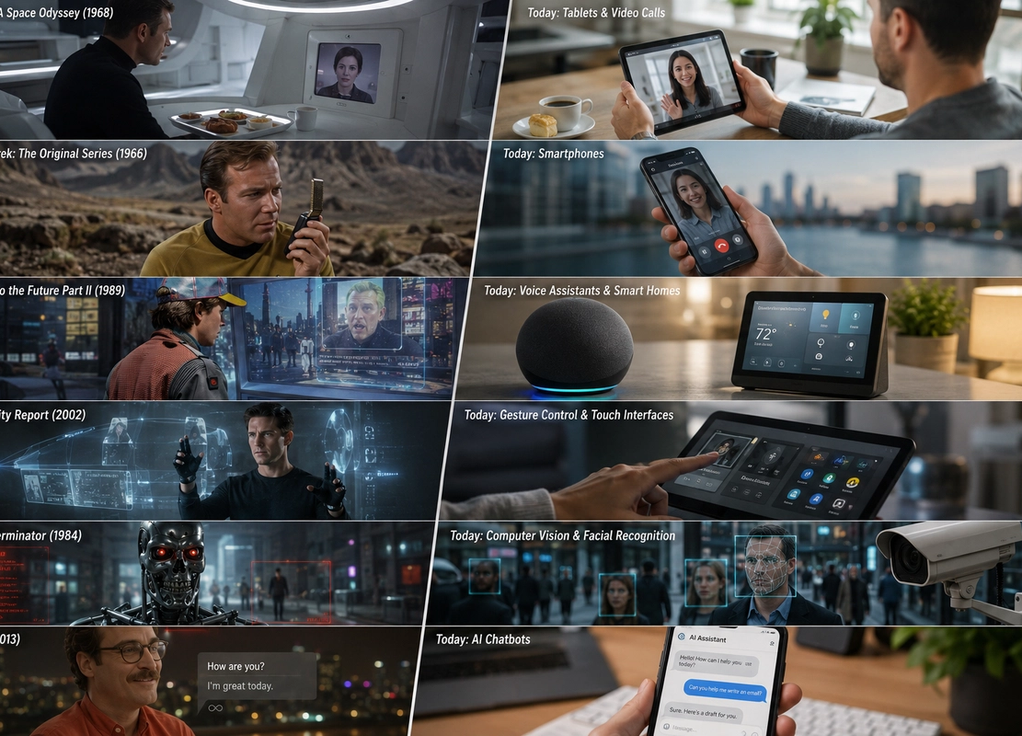
Stanley Kubrick’s 2001: A Space Odyssey, released in 1968, is filled with technology that still feels remarkably modern. One of the most frequently discussed examples is the film’s use of thin, flat personal screens that characters use while eating and traveling through space.
At a time when televisions were bulky objects, the idea of casually carrying a flat screen looked futuristic. Today, tablets and smartphones make the basic concept completely ordinary.
The film also shows video communication as a natural part of everyday life. Video calling existed conceptually before 2001, but seeing characters use it helped establish the idea that future communication would combine voice and live images.
Perhaps the film’s most famous technological idea, however, is HAL 9000. HAL can understand natural speech, respond conversationally and manage complex systems. Modern AI is nowhere near HAL’s fictional capabilities as a conscious computer, but speaking naturally to machines no longer feels like science fiction.
Star Trek helped imagine personal communicators
Star Trek began as television rather than film, but its technology became so influential across later movies and popular culture that it is difficult to leave out of any discussion about science-fiction predictions.
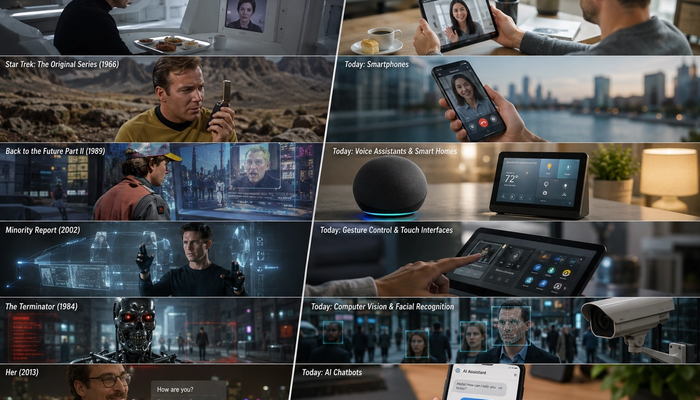
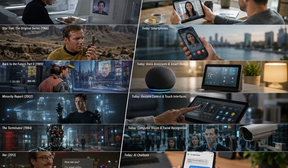
The original series featured handheld communicators that allowed characters to speak to one another from different locations. Decades later, early mobile phones drew obvious visual comparisons with the fictional devices.
Later versions of Star Trek introduced tablet-like computers, voice-controlled systems and universal translation technologies. Today, people carry touchscreen devices, ask digital assistants questions and use software that can translate speech and text almost instantly.
The similarities are not perfect, but Star Trek was particularly good at imagining technology becoming invisible and convenient. Characters did not stop to marvel at their devices.
They simply used them.
That may have been one of its most accurate predictions.
Back to the Future Part II got some things surprisingly close
When Back to the Future Part II was released in 1989, it imagined what everyday life might look like in 2015.
Some predictions were famously wrong. Hoverboards still do not float through ordinary neighborhoods, and flying cars have not replaced highways.
Other ideas were much closer.
The film showed characters communicating through large video screens, technology responding to voice commands and wearable electronic devices becoming part of everyday life. It also imagined biometric identification and increasingly automated homes.
None of these concepts appeared exactly as depicted, but the broader direction was accurate. Homes really did become filled with connected electronics, video calls became routine and voice-controlled technology entered phones, speakers, cars and televisions.
The future arrived without the hoverboards.
Minority Report made gesture control look inevitable
Released in 2002, Minority Report presented one of cinema’s most memorable futuristic computer interfaces.
Tom Cruise’s character stands in front of a large transparent display and manipulates digital information using hand gestures. He moves files, enlarges images and navigates data without a traditional mouse or keyboard.
Gesture-controlled computing now exists in several forms. Cameras and sensors can track hand movements, while virtual and augmented reality systems allow users to manipulate digital objects using controllers or their hands.
The transparent floating screens of Minority Report have not become standard office equipment, but the broader idea of interacting physically with digital information has moved much closer to reality.
Interestingly, the film also imagined highly personalized advertising that recognizes individuals as they move through public spaces. That remains much more controversial, but modern targeted advertising demonstrates that personalization became just as important to the digital future as flashy interfaces.
The Terminator imagined machines that could see
The Terminator films presented artificial intelligence in one of its most frightening forms: Skynet, an intelligent military system that eventually turns against humanity.
That scenario remains fiction.
But the films also showed machines analyzing the physical world through computer vision. The Terminator looks at people and objects while information appears across its visual field, identifying and evaluating what it sees.
Modern computer vision systems can now recognize objects, faces, text and other information in images and video. Similar technologies are used in phones, security systems, manufacturing, vehicles and AI applications.
Augmented reality can also place digital information over a view of the real world.
The capabilities and context are very different from the fictional killer robot, but the fundamental idea that computers could “look” at the world and identify what they see has become real technology.
Her anticipated conversational AI becoming personal
When Her appeared in 2013, its central technology felt both believable and distant.
The film follows a man who develops a relationship with an advanced AI operating system that communicates primarily through natural conversation.
Modern AI systems do not possess the fictional consciousness portrayed in the movie. However, the way people interact with technology has moved noticeably toward the conversational model Her imagined.
People now ask AI systems questions in ordinary language, request writing help, discuss ideas and use voice interfaces rather than navigating traditional menus for every task.
The film was particularly perceptive about something beyond technical capability: people can form emotional responses to machines that communicate convincingly.
As conversational AI becomes more capable, questions about attachment, companionship and the boundaries between human and machine interaction have moved from science-fiction discussions into real ones.
Iron Man imagined computing that surrounds you
Tony Stark’s laboratories in the Iron Man films are filled with interfaces that respond to speech, gestures and physical movement. His AI assistant, JARVIS, can retrieve information, control systems and communicate conversationally.
No real system combines those abilities at the fictional level shown in the films, but individual pieces now exist.
Smart homes can control lights and appliances through voice commands. AI assistants can process natural-language requests. Mixed-reality headsets can place digital objects into physical environments, while modern software can analyze and generate complex information rapidly.
The cinematic version remains dramatically more advanced, but the general idea of computing moving beyond keyboards and screens is increasingly visible.
Technology is gradually becoming something we speak to, wear and interact with throughout physical spaces.
Science fiction sometimes inspires the future instead of predicting it
Calling these technologies “predictions” can be misleading.
Science-fiction creators do not necessarily possess an unusual ability to see decades ahead. They observe existing science, imagine where it might lead and then build stories around those possibilities.
Sometimes engineers later grow up inspired by those same stories.
The relationship between fiction and technology can therefore move in both directions. Scientific developments inspire filmmakers, while fictional technologies give designers and engineers ideas about what future products could look like.
A science-fiction movie does not need to accurately predict the exact device that will eventually exist.
Sometimes it only needs to ask the right question.
What if computers could understand us? What if screens could fit in our hands? What if machines could recognize what they see? What if speaking to someone across the world could feel like they were sitting in front of us?
Those questions once helped make a movie feel futuristic.
Today, many of them describe things people do before breakfast.