The Best Sci-Fi Books Every Geek Should Read
Jayda Gentry
September 1, 2026
Science fiction is often described as a genre about the future, but its best books are usually interested in the present. They use spaceships, artificial intelligence, alien civilizations and impossible technologies to ask questions about power, identity, society and what humans might become.
That is also why great science fiction ages differently from other technology predictions. A fictional gadget can become outdated, but an interesting idea rarely does. Books written decades ago can suddenly feel relevant again when artificial intelligence advances, surveillance expands or technology changes the way people communicate.
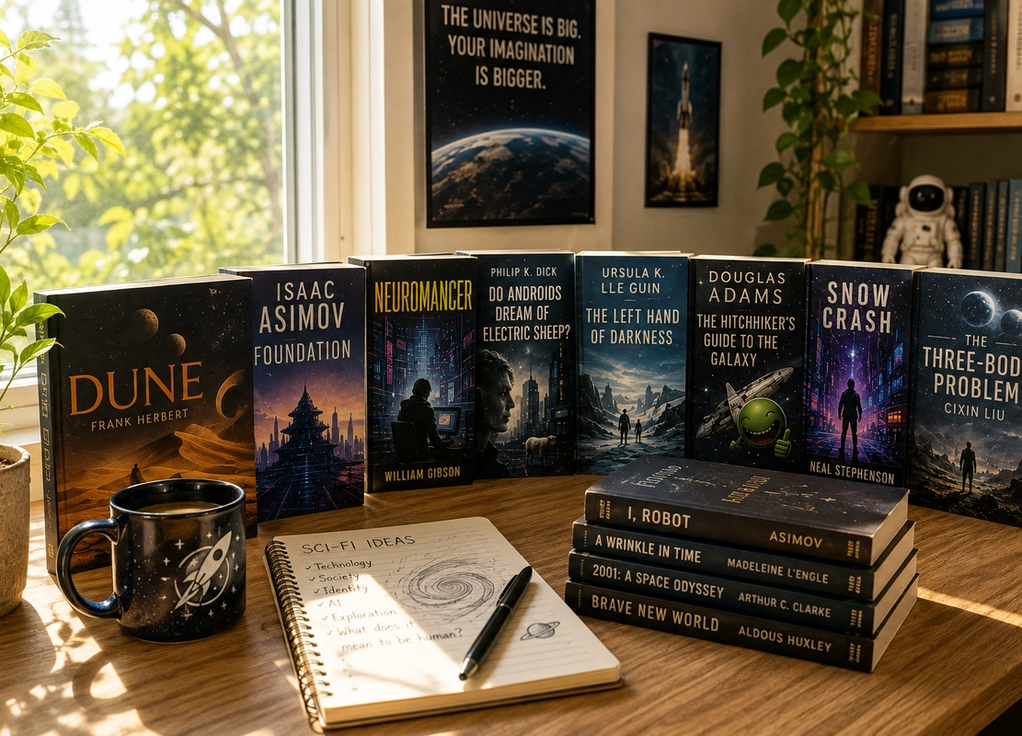
There is no definitive list of science-fiction books everyone has to read. The genre is far too large for that. But some novels changed science fiction itself, while others introduced ideas that continue appearing in technology, films, games and internet culture. If you want to understand why geeks keep arguing about fictional universes long after midnight, these are excellent places to start.
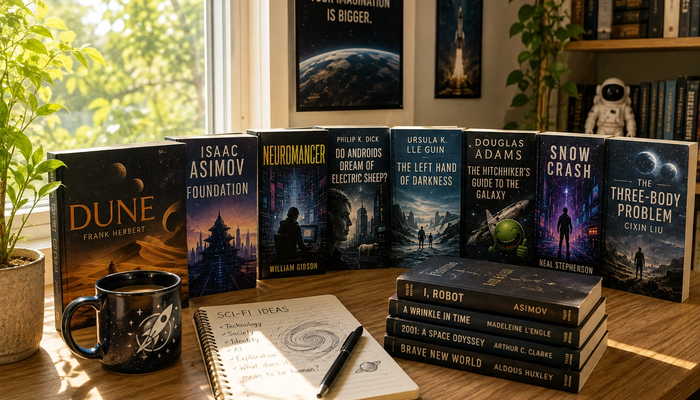
Dune turns science fiction into politics and mythology
Frank Herbert’s Dune is one of the giants of science fiction, but it is surprisingly different from the technology-heavy story some new readers expect.
Set thousands of years in the future, the novel follows competing families, political powers and religious forces surrounding the desert planet Arrakis, the only source of an extraordinarily valuable substance known as spice.
The technology is fascinating, but the real story is about power.
Herbert explores colonialism, environmental limits, religion, charismatic leaders and the consequences of trying to control complicated societies. Arrakis itself is almost a character, with its ecology shaping everything from politics to culture.
The result feels less like a conventional space adventure and more like an enormous historical epic that happens to take place in the future.
Foundation asks whether history can be predicted
Isaac Asimov’s Foundation begins with an enormous idea: what if mathematics could predict the behavior of entire civilizations?
In the novel, mathematician Hari Seldon develops “psychohistory,” a fictional science capable of forecasting large-scale social change. He predicts that a vast galactic empire is approaching collapse and creates a plan intended to shorten the period of chaos that will follow.
The story unfolds across generations rather than focusing on one traditional hero.
That scale is part of what made Foundation so influential. Instead of treating a galactic empire simply as a backdrop for adventure, Asimov asks how enormous civilizations rise, decline and respond to crises.
Anyone interested in systems, prediction and the limits of planning will find plenty to think about.
Neuromancer imagined cyberspace before the web took over
William Gibson’s Neuromancer was published in 1984, years before the World Wide Web became part of ordinary life.
Yet its world feels strangely recognizable.
Hackers navigate digital networks, corporations hold enormous power, artificial intelligence plays a central role and technology is deeply integrated into people’s bodies and identities.
Gibson helped popularize the concept of “cyberspace” and became one of the defining voices of cyberpunk.
The technology is not a literal prediction of today’s internet, but the atmosphere can feel remarkably familiar: global networks, digital crime, corporate technology and the idea that virtual spaces can become places where important parts of life happen.
A huge amount of later science-fiction culture owes something to Neuromancer.
Do Androids Dream of Electric Sheep? asks what makes someone human
Philip K. Dick’s Do Androids Dream of Electric Sheep? is widely known as the novel that inspired Blade Runner, although the book and film differ significantly.
The story follows bounty hunter Rick Deckard as he tracks advanced androids that are almost impossible to distinguish from humans.
That setup creates a much larger question.
If a machine can look human, communicate like a human and apparently experience something resembling emotion, what exactly separates it from us?
The novel explores empathy, identity and artificial life without offering easy answers.
Those questions have become even more interesting as real AI systems have become increasingly capable of producing language and behavior that people instinctively interpret in human terms.
The Left Hand of Darkness uses aliens to examine humanity
Ursula K. Le Guin demonstrated that science fiction did not need enormous battles or complicated machines to explore radical ideas.
The Left Hand of Darkness follows a human envoy visiting a planet whose inhabitants do not experience gender in the same fixed way as humans.
Le Guin uses that premise to explore identity, culture, politics and the assumptions people carry into unfamiliar societies.
The novel is a good reminder that some of science fiction’s most powerful technologies are simply ideas.
By changing one fundamental aspect of human experience and imagining the society that might develop around it, Le Guin makes familiar social structures suddenly look strange.
That ability to make readers reconsider what they assumed was normal is one of science fiction’s greatest strengths.
The Hitchhiker’s Guide to the Galaxy makes the universe ridiculous
Not every great science-fiction book needs to be serious.
Douglas Adams’s The Hitchhiker’s Guide to the Galaxy begins with Earth being demolished to make way for an interstellar bypass and becomes increasingly absurd from there.
The novel is packed with aliens, robots, spaceships and impossible technology, but its real target is often bureaucracy, human behavior and our tendency to treat ourselves as far more important than we probably are.
Its influence on geek culture is enormous.
References to the number 42, towels and the phrase “Don’t Panic” escaped the book long ago and became part of the broader language of science-fiction fandom.
It is also an ideal choice for someone who likes clever ideas but does not necessarily want several hundred pages of serious galactic politics.
Snow Crash predicted an internet culture rather than an internet
Neal Stephenson’s Snow Crash, published in 1992, imagines a future where people enter a shared virtual environment called the Metaverse.
The word itself became enormously influential decades later.
But the book’s relevance goes beyond virtual reality. It imagines online identities, digital economies and virtual spaces where status and social interaction matter.
That feels particularly familiar in an era of online games, social platforms, avatars and digital goods.
Like much cyberpunk, the novel exaggerates its world deliberately. The future it depicts is chaotic, commercialized and often ridiculous.
Yet underneath that exaggeration are ideas about how digital environments could become genuine extensions of social life.
The Three-Body Problem thinks on a civilization-sized scale
Liu Cixin’s The Three-Body Problem brings a different perspective to modern science fiction.
The novel begins with mysterious scientific events and gradually expands into a story involving humanity’s potential encounter with an extraterrestrial civilization.
What makes it particularly compelling is its scale.
Scientific ideas sit alongside questions about whether humanity could cooperate when facing a threat larger than any individual nation. The story also explores how different people might respond to discovering that intelligent life exists elsewhere.
For readers who enjoy science fiction that continually increases the size of the questions it asks, the trilogy that begins here goes very, very big.
The best science fiction leaves you thinking after the technology disappears
You do not need to read science fiction chronologically or begin with the book considered most historically important.
Choose the question that interests you.
If you want politics and world-building, start with Dune. If artificial intelligence and identity fascinate you, try Philip K. Dick. For cyberpunk, choose Neuromancer or Snow Crash. If you want social science fiction, Ursula K. Le Guin is essential. If you want enormous cosmic ideas, The Three-Body Problem is difficult to ignore. And if all of that sounds too serious, Douglas Adams is waiting to remind you how ridiculous the universe can be.
The best science fiction does not simply show you futuristic technology.
It changes the angle from which you look at your own world.
You close the book, return to reality and notice that reality suddenly looks a little more like science fiction than it did before.