The Strangest Gadgets Sold on Late-Night TV
Jayda Gentry
September 11, 2026
Before online shopping made it possible to buy almost anything at any hour, late-night television had its own version of the endless scroll: the infomercial.
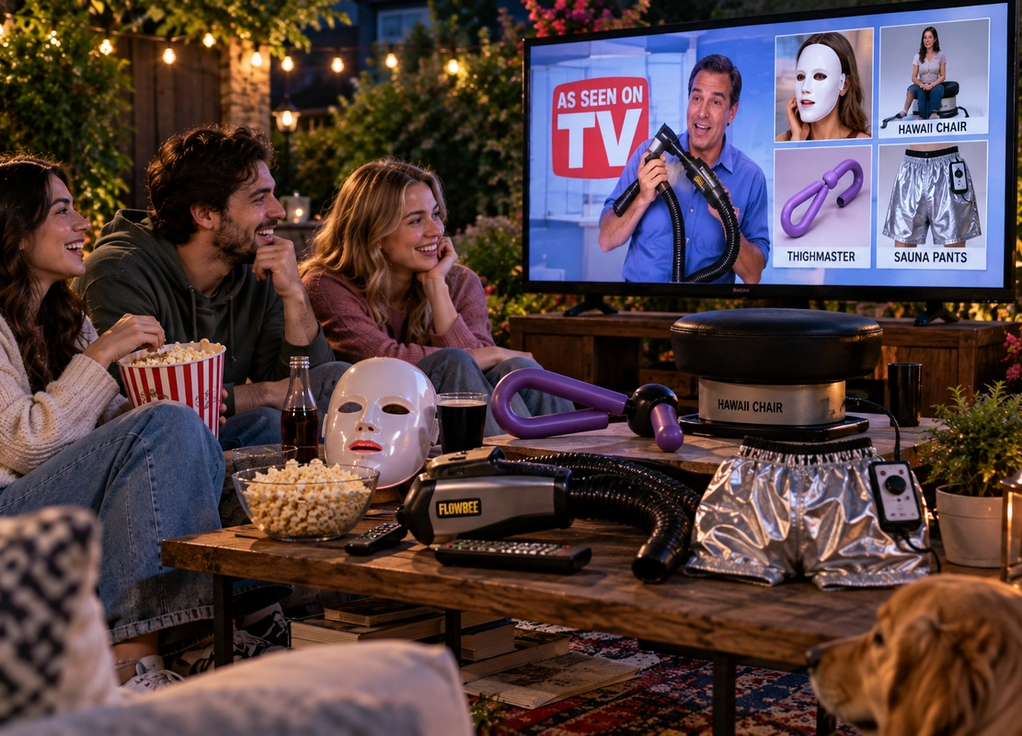
Stay awake long enough and ordinary programming gave way to enthusiastic presenters demonstrating products you had probably never considered needing. There were exercise machines promising results while you sat down, beauty devices that looked like science-fiction props and household inventions designed to solve problems most people did not realize they had.
Some became genuinely successful. Others disappeared almost as quickly as they arrived. Together, they created a wonderfully strange period of consumer culture in which almost any gadget could seem essential after watching someone demonstrate it enthusiastically at 2 a.m.
The Flowbee attached a haircut to your vacuum cleaner
The Flowbee remains one of the great achievements of infomercial logic.
Haircuts create loose hair. Vacuum cleaners remove loose material. Why not combine the two?
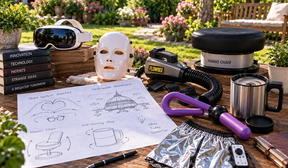
The device connected a hair-cutting attachment to a household vacuum cleaner. Suction pulled the hair into the attachment while built-in blades cut it to a selected length, with the vacuum simultaneously collecting the clippings. It became strongly associated with late-night infomercials and developed enough of a following to survive long beyond its original television fame. (Los Angeles Times)
It sounds like a comedy sketch, but the basic engineering idea is surprisingly reasonable. Holding hair at a consistent distance from the blades can help produce an even cut, while immediately vacuuming the clippings reduces mess.
That combination perfectly captures the appeal of classic TV gadgets. The product needed to look slightly ridiculous while solving a problem clearly enough that, after five minutes of watching the demonstration, viewers might start thinking it was actually brilliant.
The Hawaii Chair promised exercise without leaving your desk
Exercise requires movement.
The Hawaii Chair attempted to solve this inconvenience by letting the chair do much of the moving for you.
Its motorized seat rotated the user’s hips in a hula-like motion while they remained seated. Advertisements suggested people could use it while performing ordinary office activities such as answering phones and working at a computer. TIME reported that its motor operated at 2,800 rpm and that the product was promoted around the idea of getting fit while sitting. (content.time.com)
The demonstration was arguably more memorable than the fitness proposition.
Watching someone attempt to type or hold a professional conversation while their lower body moved in circles made the Hawaii Chair perfect late-night television.
It also represented one of the most durable categories in infomercial history: exercise products promising to make working out require considerably less actual working out.
Rejuvenique looked like something from a horror movie
Beauty gadgets have produced some of the strangest infomercials ever broadcast, but the Rejuvenique Electric Facial Mask deserves special recognition.
The hard facial mask contained contact points designed to deliver electrical stimulation to different areas of the face. It was promoted as a way of exercising facial muscles and creating a more toned, youthful appearance. Actress Linda Evans famously appeared in its advertising in the late 1990s. (content.time.com)
There was one unavoidable problem.
The mask looked terrifying.
Covering almost the entire face with openings for the eyes and mouth, it resembled a prop from a horror film far more than a relaxing beauty treatment.
That visual contrast made the infomercial unforgettable. The presenter could calmly discuss beauty benefits while the person wearing the product looked ready to appear in the final scene of a slasher movie.
The ThighMaster turned squeezing into a fitness empire
Not every strange late-night gadget disappeared.
The ThighMaster became a genuine cultural phenomenon.
The resistance device was placed between the legs and repeatedly squeezed to exercise the muscles. Suzanne Somers became closely associated with the product through television advertising during the 1990s, helping turn a remarkably simple piece of exercise equipment into one of the era’s most recognizable fitness products. (Wikipedia)
Part of its appeal was convenience.
You did not need a gym, complicated equipment or even much space. Advertising showed that the device could be used while watching television or doing other activities.
The product was easy to understand within seconds, which made it ideal for television.
See device. See person squeeze device. Understand immediately what device supposedly does.
That simplicity is one of the secrets behind many successful infomercial products.
Sauna pants tried to make sweating a gadget
Some late-night fitness products were less interested in movement than in finding creative ways to make people sweat.
Sauna pants took that concept extremely literally.
Versions of the product appeared as oversized heated shorts designed around the idea of producing sauna-like heat around the waist, hips and thighs. Advertisements promoted them as an effortless way to target those areas. (GOBankingRates)
The visual result was difficult to ignore.
Some versions looked like inflatable shorts connected to controls, somewhere between exercise equipment and a costume from a very low-budget science-fiction film.
Products like these reflected a recurring theme in television fitness marketing: if exercise was difficult, perhaps technology could create a shortcut.
That promise proved remarkably powerful, even when the gadget itself looked deeply strange.
The Neckline Slimmer targeted one extremely specific problem
Infomercials were excellent at convincing viewers that a small inconvenience required its own specialized device.
The Neckline Slimmer was designed around exercising the neck and jaw area. The user placed the device beneath the chin and repeatedly pressed downward against resistance.
Advertising promoted it as a way to improve the appearance of the jawline and neck. (Gizmodo)
It was an almost perfect television product because its use could be demonstrated immediately.
There was no complicated setup or explanation.
Place strange object under chin. Push head downward repeatedly. Imagine transformation.
Whether viewers actually needed a dedicated device for this particular movement was another question.
Late-night television rarely allowed questions like that to interrupt a good demonstration.
Strange gadgets were perfect for television
There was a reason these products flourished in infomercials.
Television rewarded gadgets that produced visible demonstrations.
A presenter could show someone struggling with an ordinary task, introduce the product and immediately demonstrate how much easier life became.
The problem was often exaggerated deliberately.
Someone trying to cut vegetables without the advertised kitchen gadget suddenly appeared incapable of safely operating a knife. A person folding an ordinary blanket became inexplicably trapped. Exercise without a special machine looked impossibly exhausting.
Then the gadget appeared.
Problem solved.
The stranger the invention, the more memorable the demonstration could become.
The sales pitch was part of the product
Classic infomercials also developed their own language.
The price would fall unexpectedly. Another product would be included. Then another bonus would appear if you ordered immediately.
The goal was to create urgency.
You were not simply buying a kitchen tool or exercise gadget. You were apparently receiving an unbelievable collection of life-changing technology available under circumstances that might disappear at any moment.
The format worked particularly well late at night, when viewers were watching casually and the enthusiastic presentation itself could become entertainment.
Sometimes people bought the gadget because they genuinely wanted it.
Sometimes the commercial was simply too convincing to resist.
Late-night gadgets were the original viral products
The classic infomercial has lost some of its cultural power, but the basic formula never disappeared.
It moved online.
Today, unusual products spread through short videos, influencers, livestream shopping and social media advertisements. A satisfying demonstration can reach millions of viewers within hours.
The language changed, but the psychology is remarkably familiar.
Show a recognizable problem. Introduce an unexpectedly clever gadget. Demonstrate it dramatically. Make purchasing effortless.
Late-night television was doing the same thing decades ago.
That may be why products such as the Flowbee, Hawaii Chair and Rejuvenique remain so memorable. They belonged to a period when discovering a bizarre new gadget did not require an algorithm.
You simply had to stay awake long enough.
And somewhere between midnight and sunrise, someone on television would inevitably explain why your life had been incomplete without a vacuum-powered haircut.