The Gadgets Worth Buying (And the Ones That Are a Waste)
Ryker Ware
September 1, 2026
The technology industry is extremely good at convincing us that one more gadget will make life easier.
There is a device for tracking your sleep, another for charging your phone, another for controlling your lights and probably something Bluetooth-enabled for a household task that never needed Bluetooth in the first place. Some of these products genuinely solve everyday problems. Others are exciting for approximately three days before moving permanently into a drawer.
The difference is rarely how futuristic a gadget looks. The technology most worth buying usually solves a problem you already have, saves time repeatedly or replaces several less convenient tools. Current consumer-tech testing still tends to highlight practical categories such as power banks, e-readers, headphones and certain wearables rather than novelty devices with unclear everyday value. (FAZ.NET)
Before buying another gadget, the useful question is not “What can this do?” It is “How often will I actually need it?”
A good power bank is boring but genuinely useful
Few gadgets are less exciting than a portable battery, but few are easier to justify.
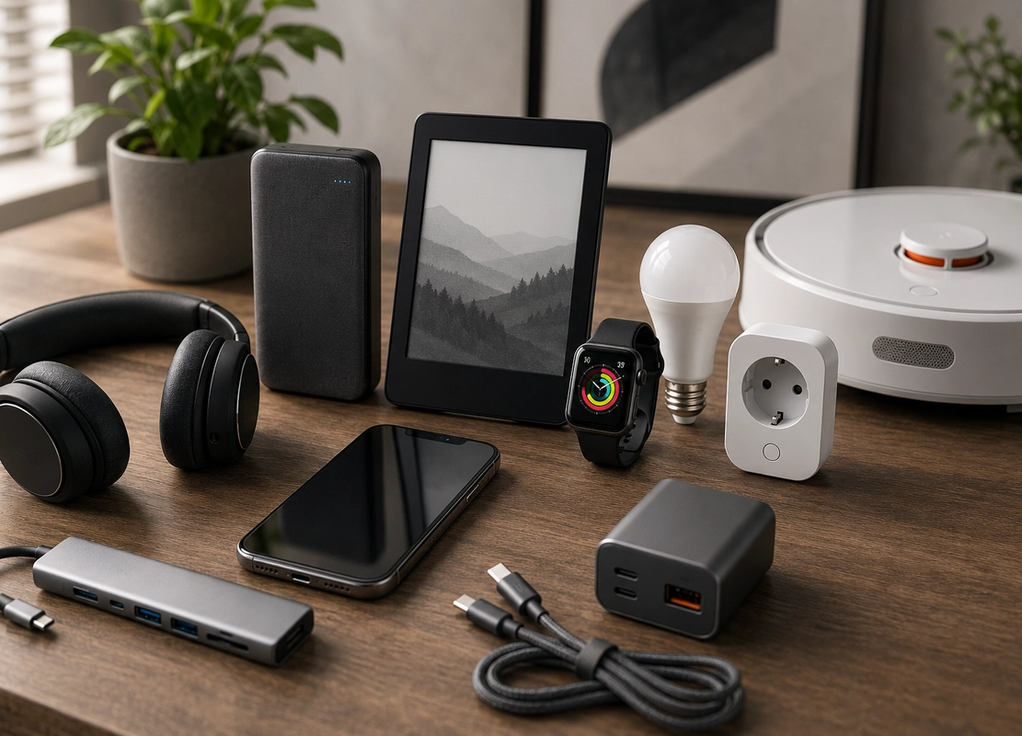
Phones now handle navigation, payments, tickets, communication, cameras and countless other tasks. Running out of battery when you are away from a power outlet can therefore be much more than a minor inconvenience. A reasonably sized power bank solves that problem directly, particularly when traveling, commuting or spending long periods away from home. Current buying guides continue to treat power banks as practical everyday accessories for phones and other portable devices. (Popular Mechanics)
The key is buying for your actual needs rather than choosing the largest capacity available. An enormous battery that can charge several laptops is unnecessary if you only want emergency power for your phone. A smaller model that comfortably fits in your bag may get far more use.
That principle applies to gadgets generally. The best specification is not always the biggest number. It is the one you will realistically carry and use.
Good headphones earn their place quickly
Headphones are another category where spending money can make sense because many people use them constantly.
A comfortable pair of wireless earbuds can be useful for commuting, exercise, calls and everyday listening. Noise-canceling headphones become particularly valuable for people who frequently travel, work in shared spaces or simply want to reduce distracting background noise. Headphones remain among the most heavily used consumer devices, with recent German research reporting an average of 12.7 hours of weekly use among headphone users. (Bitkom e. V.)
That does not mean everyone needs premium headphones. Someone who listens to a podcast for twenty minutes each morning may be perfectly satisfied with an inexpensive pair.
The value comes from frequency of use. Paying more for something you wear for several hours every day can make more sense than spending the same amount on an impressive gadget you use twice a month.
An e-reader is worth it if you actually read
An e-reader is a perfect example of a specialized gadget that can either be fantastic or completely unnecessary.
If you regularly read books, an e-reader offers clear advantages. It can store a large library in a lightweight device, and E-Ink displays are designed specifically to provide a comfortable reading experience. Current consumer testing still points to portability and paper-like readability as major reasons e-readers remain useful despite tablets and large smartphones. (FAZ.NET)
If you read two books a year, however, buying another screen probably will not transform you into someone who reads fifty.
This is a common mistake with technology. We sometimes buy gadgets for the person we imagine becoming rather than the person we currently are.
Fitness gadgets will not automatically create an exercise habit. An expensive camera will not make you start taking photographs every weekend. A sophisticated kitchen device will not turn someone who dislikes cooking into a passionate home chef.
Buy technology that supports habits you already value, not technology that depends on developing an entirely new personality.
Smartwatches are useful for some people and pointless for others
Smartwatches sit directly on the line between useful technology and unnecessary gadget.
For someone who tracks workouts, uses navigation, wants quick access to notifications or regularly uses contactless payments, a smartwatch can become something they interact with throughout the day.
For someone who mainly checks the time, it can become a very expensive watch that needs charging.
That is why there is no universal answer about whether a smartwatch is worth buying. Even current consumer guides describe them as useful additions for some people rather than essential devices for everyone. (FAZ.NET)
Before buying one, identify three things you expect to use regularly. If you cannot, there is a reasonable chance you are attracted to the gadget rather than its usefulness.
Smart-home gadgets should remove work, not create it
Smart-home technology is at its best when it quietly removes repetitive tasks.
A robot vacuum that regularly cleans floors can save real time in the right home. Smart lights can be useful when automated around routines. Smart thermostats can make temperature control easier.
The problem begins when making an ordinary object “smart” creates more work than it removes.
A device that requires another account, another app, frequent updates and constant troubleshooting needs to provide enough value to justify that complexity.
Nobody needs to spend five minutes reconnecting a smart appliance to Wi-Fi to perform a task that previously required pressing one button.
A useful smart-home gadget should eventually disappear into your routine. If you are constantly managing the technology itself, the supposedly smart solution may have created a new problem.
Cheap novelty gadgets are often expensive in disguise
A €20 gadget does not feel like a major purchase, which is precisely why inexpensive technology can accumulate so easily.
Mini projectors, strange phone accessories, tiny printers, unnecessary USB devices and countless social-media-famous products can look irresistible in short videos.
Individually, the risk seems small.
But five disappointing €30 gadgets cost the same as one genuinely useful €150 product.
Cheap electronics can also involve compromises in battery quality, software support, durability or privacy. If an unknown smart device requires an account and constant internet access, it is worth considering what service will keep that product functioning several years from now.
The cheapest gadget is not a bargain if it quickly becomes electronic waste.
Single-purpose gadgets need to justify themselves
A specialized gadget is not automatically bad. Some of the best technology is extremely specialized.
The question is whether it performs its one job substantially better than something you already own.
Your smartphone already contains a camera, flashlight, GPS receiver, music player, voice recorder, calculator, scanner and many other tools. Buying separate devices that duplicate those functions only makes sense when the dedicated gadget provides a meaningful advantage.
A dedicated camera can offer capabilities far beyond a phone for someone serious about photography. A GPS sports watch can be valuable to a committed runner. An e-reader can provide a better experience for someone who reads every night.
But if the dedicated device performs essentially the same task only slightly differently, it may spend more time being charged than being used.
Be skeptical of gadgets that require permanent subscriptions
Another hidden cost appears when buying the device is only the beginning.
Some gadgets place important features, historical data or cloud services behind recurring subscriptions. That can turn an affordable purchase into a much more expensive product over several years.
Subscriptions are not automatically bad. Maintaining servers and continually developing software costs money, and a genuinely valuable service can justify an ongoing fee.
The important thing is knowing what happens if you stop paying.
If the hardware loses much of its usefulness without a subscription, calculate the long-term cost rather than judging the gadget by its purchase price alone.
A €100 device with a €10 monthly subscription is not really a €100 device if you intend to use it for five years.
Upgrade existing technology before adding more of it
Sometimes the best gadget purchase is not a new category of gadget at all.
A better charger can be more useful than another smart device. One sufficiently powerful USB-C charger may replace several adapters. A replacement laptop battery can extend the useful life of a computer. A better router can improve the experience of every connected device in a home.
These purchases are not particularly exciting because they improve something you already own rather than introducing something new.
But useful technology does not have to be exciting.
It has to be useful.
The best gadget passes a simple test
Before buying something, imagine the novelty has disappeared.
It is six months later. Nobody is talking about the product anymore. There are newer versions available, and the unboxing experience is long forgotten.
Would you still reach for it?
If the answer is yes because it saves time, solves a recurring problem or makes something you already do noticeably better, it is probably a worthwhile gadget.
If the main attraction is that it looks clever, futuristic or satisfying in a 30-second video, waiting a week before buying it is often a good idea.
The gadgets worth owning tend to become boring surprisingly quickly because they disappear into everyday life. You stop thinking about the power bank in your bag, the headphones you use every morning or the charger sitting on your desk.
The gadgets that are a waste often do the opposite.
They are fascinating when you buy them and forgotten once you actually own them.
That may be the simplest rule for buying technology: spend money on gadgets that solve boring problems, not gadgets whose main purpose is being interesting.