How Wireless Charging Actually Works
Alena Marks
September 1, 2026
Wireless charging can feel almost like a magic trick. You place your phone on a charging pad, hear the familiar charging sound, and the battery begins filling up even though there is no cable plugged into the phone. Nothing appears to connect the charger to the battery, yet electrical energy is somehow crossing the small gap between them.
The explanation is not quite as mysterious as it looks. Wireless charging uses electromagnetic fields to transfer energy between two coils: one inside the charger and another inside the device. The technology is based on a principle called electromagnetic induction, which has been understood for nearly two centuries. Modern electronics have simply made it small, efficient and convenient enough to put inside everyday devices.
Electricity creates a magnetic field
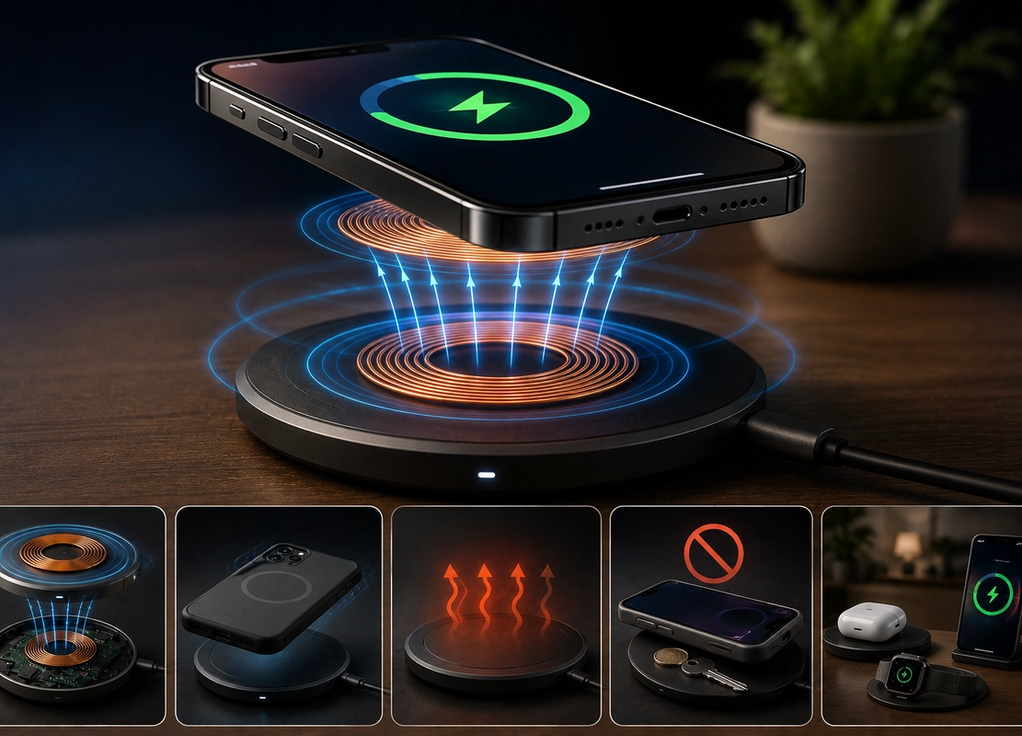
The first step happens inside the charging pad. When electricity flows through a coil of wire in the charger, it creates a magnetic field around that coil. The charger uses alternating current, meaning the direction of the electrical current changes rapidly. As the current changes direction, the magnetic field changes with it.
That changing magnetic field is the key to wireless charging. A steady magnetic field on its own would not continuously transfer the energy needed to charge the phone. By rapidly changing the field, the charger creates the conditions necessary to induce an electrical current in another nearby coil. This allows energy to cross a small physical gap without requiring metal charging contacts to touch each other.
Your phone contains another coil
A compatible smartphone contains its own receiving coil, usually positioned toward the back of the device. When you place the phone on a wireless charger, this receiving coil enters the changing magnetic field produced by the charging pad.
The changing field induces an electrical current in the phone’s coil. Electronics inside the phone then convert and regulate that electricity into a form that can safely charge the battery. In other words, electricity in the charging pad creates a magnetic field, that magnetic field creates electricity inside the phone, and the phone uses the resulting electrical energy to recharge its battery.
There is no invisible electrical cable connecting the two devices. Energy is being transferred through the electromagnetic interaction between the coils.
Alignment makes a big difference
The two coils need to be reasonably close and properly aligned for wireless charging to work efficiently. This is why a phone may stop charging if you place it too far toward the edge of an older charging pad. The transmitting and receiving coils are no longer positioned well enough for efficient energy transfer.
Modern systems have introduced ways to make alignment easier. Magnetic alignment can guide the device into the correct position, while newer charging standards and accessories can help ensure the two coils remain centered over each other. Some larger charging pads also use multiple coils to provide a wider usable charging area.
Good alignment does more than make charging reliable. It also helps reduce wasted energy. When the coils are poorly positioned, less of the energy produced by the charger reaches the phone effectively, and more may be lost as heat.
Wireless charging is not truly wireless
The term “wireless charging” is slightly misleading because the charger itself still needs electricity. In most cases, the charging pad has a cable connecting it to a wall adapter or another power source.
The wireless part is only the short distance between the charging surface and the device.
This is why today’s wireless charging is better understood as cable-free charging for the device rather than electricity being transmitted freely across a room. The phone does not need a charging cable inserted into its port, but the system still depends on a wired power source somewhere nearby.
There are technologies being explored for transferring useful amounts of energy across longer distances, but the wireless charging used by most phones, earbuds and watches is designed to work across a very small gap.
Why wireless charging creates heat
Wireless charging is not perfectly efficient. Some of the electrical energy involved in the process is lost rather than reaching the battery, and part of that lost energy becomes heat.
This is why your phone and charging pad may feel warm during a wireless charging session. The amount of heat depends on factors such as charging power, alignment, charger design, the phone’s temperature and even the case surrounding the device.
Phones have systems designed to manage this. If the device becomes too warm, it may reduce charging speed or temporarily stop charging to protect the battery and internal components. A small amount of warmth can be normal, but excessive heat can reduce efficiency and is something charging systems are designed to avoid.
Wired charging generally has an efficiency advantage because electrical energy travels through a direct physical connection rather than being transferred between two coils.
Phone cases can affect the connection
Wireless charging is designed to work through a small amount of material, which is why you normally do not need to remove a standard phone case every time you charge.
However, distance matters. A particularly thick case increases the space between the transmitting and receiving coils, which can make energy transfer less effective. Certain materials or objects placed between the phone and charger can also interfere with charging.
Metal objects are particularly problematic. This is one reason manufacturers warn against placing coins, keys or other metallic items between a phone and wireless charger. Well-designed chargers can detect some foreign objects and reduce or stop power transmission when necessary.
Cases specifically designed for wireless or magnetic charging usually take coil positioning and magnetic alignment into account, making the experience more reliable.
Different devices use the same basic idea
Phones are not the only products that can charge without a traditional charging connector. Wireless earbuds, smartwatches and other small electronics can use similar principles, although the exact implementation may vary.
One major standard for wireless charging is Qi, developed by the Wireless Power Consortium. Having a common standard allows compatible devices and chargers from different manufacturers to work together rather than requiring every company to invent an entirely separate charging system.
Newer versions of wireless charging technology have also improved alignment and efficiency. Better communication between the charger and device allows them to determine how much power should be transferred and adjust the charging process accordingly.
The result is a system that looks extremely simple to the user even though the charger and device are constantly coordinating behind the scenes.
Wireless charging trades efficiency for convenience
If plugging in a cable can be faster and more efficient, why use wireless charging at all?
Convenience is the main answer. You can place a phone on a charging stand while working, drop earbuds onto a charging surface or leave a charger beside the bed without repeatedly connecting and disconnecting a cable. There is also less physical wear on the device’s charging port.
For some people, those advantages matter more than maximum charging speed. For others, particularly when they need to recharge a battery quickly, a wired charger may still make more sense.
Wireless charging is therefore not necessarily a replacement for cables in every situation. It is another way of delivering power that prioritizes ease of use.
The technology is simpler than it looks
The entire process can ultimately be reduced to a surprisingly straightforward chain of events. Electricity flows through a coil in the charging pad and creates a changing magnetic field. A second coil inside the phone enters that field, causing an electrical current to form inside it. The phone’s electronics regulate that current and use it to charge the battery.
All of this begins automatically when you place the device in the correct position.
There is no secret battery hidden in the charging pad and no electricity mysteriously jumping through open space. Wireless charging works because electricity and magnetism are closely connected, allowing energy to move between two nearby coils without a direct electrical contact.
So the next time you place your phone on a charging pad, what looks like one effortless action is actually a carefully controlled transfer of energy through an electromagnetic field. The cable may have disappeared from the phone, but the physics underneath the charging process has been around for a very long time.