How the Internet Actually Works (Explained Simply)
Luna Giles
September 1, 2026
The internet can feel almost magical.
You type a website address, press Enter and a page appears. You send a photograph to someone thousands of kilometers away and they receive it seconds later. You press play on a video and information begins traveling to your screen almost immediately.
But the internet is not floating invisibly in the air, and your phone is not communicating directly with every website you visit.
At its simplest, the internet is an enormous network of connected computers. Your device sends requests through that network, other computers respond, and information travels back and forth incredibly quickly.
Once you understand that basic idea, the internet becomes much less mysterious.
The internet is a network of networks
The word “internet” comes from the idea of interconnected networks.
Your home has a small network. Your phone, laptop, television and other devices may all connect to the same router. Your router connects your home to an internet service provider, or ISP.
That provider is connected to larger networks, which connect to other networks around the world.
Together, these connections form the internet.
There is no single computer running the entire thing and no one central location where “the internet” lives.
Instead, millions of computers, servers, routers, cables and data centers cooperate using agreed technical standards.
When you access something online, information can pass through several parts of this enormous system before reaching you.
Websites live on servers
A website has to exist somewhere.
Its files are typically stored on computers called servers. Servers are designed to provide information or services to other computers over a network.
Imagine opening a news website.
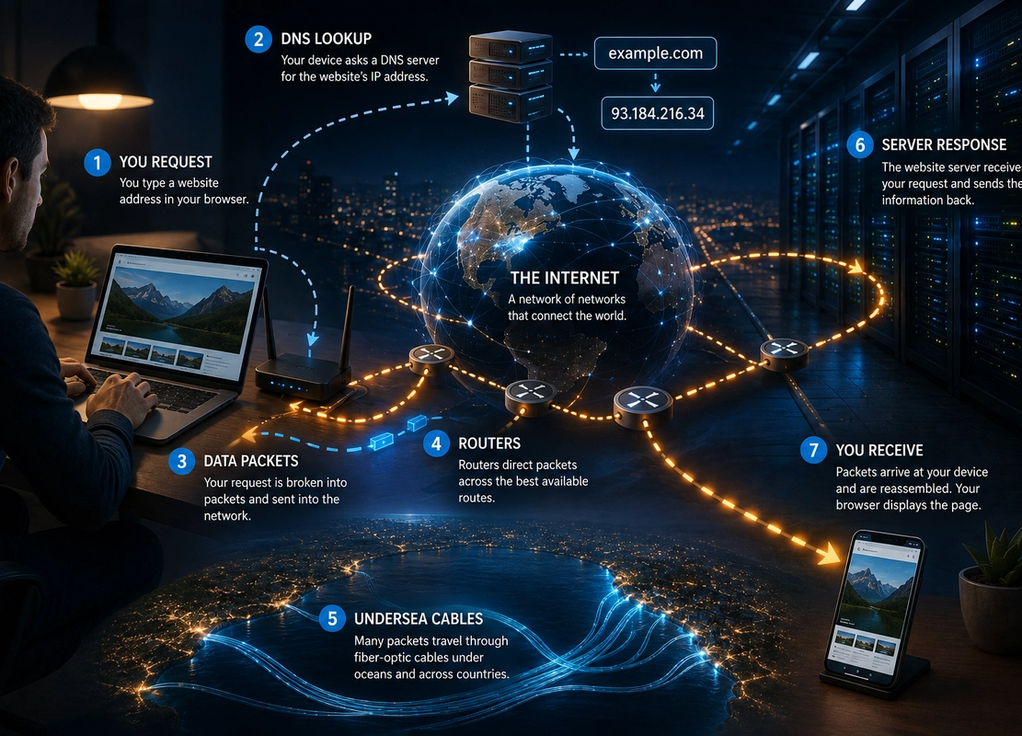
Your phone or computer sends a request asking the site’s server for the information needed to display the page. The server receives that request and sends data back.
Your browser then takes that information and turns it into the page you see.
The same basic relationship appears across the internet.
Your device acts as a client requesting something, while another computer provides it.
Of course, modern websites can be much more complicated. A single page may retrieve information from several servers and services. But the basic exchange remains surprisingly simple: your device asks, and another machine responds.
Domain names make addresses easier for humans
Computers connected to the internet need addresses so information knows where to go.
These are called IP addresses.
The problem is that numerical addresses are not particularly convenient for humans to remember. It is much easier to remember a name such as example.com than a sequence of numbers.
That is where the Domain Name System, or DNS, comes in.
DNS works a little like the internet’s contact list.
When you enter a domain name, your device can use DNS to find the corresponding IP address. Once it knows where the server is, it can begin communicating with it.
Most of this happens automatically and extremely quickly.
You type a recognizable name.
Behind the scenes, computers translate that name into an address they can use.
Information travels in packets
When information moves across the internet, it is generally divided into smaller pieces called packets.
Imagine sending a large book through the mail, except instead of placing the entire book in one enormous package, you separate it into many smaller packages.
Each packet contains part of the information along with details that help the network determine where it needs to go.
Routers then help direct those packets through the internet.
Interestingly, packets belonging to the same piece of information do not necessarily need to follow exactly the same route. The network can direct traffic depending on available connections and conditions.
When the necessary data reaches its destination, it can be put back together in the correct form.
This system helps make the internet flexible and resilient.
Most international internet traffic travels through cables
Wi-Fi makes the internet feel wireless, but much of the internet is extremely physical.
Your phone may communicate wirelessly with your router, but from there, information often travels through cables.
Fiber-optic cables carry enormous amounts of internet traffic using pulses of light. Some of these cables stretch across cities and countries.
Others run underneath oceans.
Submarine cables connect continents and carry a huge share of international internet traffic. When you access information hosted in another country, your data may travel through one of these cables before reaching its destination.
Satellites also provide internet connectivity, particularly where traditional infrastructure is difficult to build, but the global internet still relies heavily on physical cable networks.
The cloud, despite its name, has a lot of wires.
Routers help data find its destination
The internet contains an enormous number of possible routes.
Routers help decide where data should go next.
Your home router performs this job on a small scale by directing information between your devices and the wider internet. Larger routers operated by internet providers and network companies help move traffic across much greater distances.
You can think of them as intersections in a gigantic transportation system.
A packet arrives with information about its destination, and the router determines where it should travel next.
This process happens repeatedly until the information reaches the correct network and eventually the correct device or server.
All of these decisions can happen so quickly that a website on another continent may respond in a fraction of a second.
Wi-Fi and the internet are not the same thing
Wi-Fi is often used as another word for internet access, but they are different things.
Wi-Fi is a technology that allows devices to communicate wirelessly over a local network.
The internet is the much larger network your router connects to.
This is why your phone can show a strong Wi-Fi signal while a website refuses to load.
Your phone may have an excellent connection to the router, but the router itself may have lost its connection to the internet.
Mobile data provides another route. Instead of connecting through your home router, your phone communicates with a cellular network, which then connects you to the wider internet.
Different path, same internet.
Streaming works by continuously sending data
When you stream a film or song, you usually do not wait for the entire file to arrive before it starts playing.
Instead, data is delivered continuously.
Your device temporarily stores a small amount ahead of what you are currently watching or listening to. This is called buffering.
If the connection remains fast enough, new data arrives before you need it and playback feels continuous.
If the connection becomes too slow, the stored data can run out.
That is when the dreaded loading symbol appears.
Streaming services can also adjust quality based on your connection. A weaker connection may produce lower-quality video because smaller amounts of data can be delivered more reliably.
The internet works because everyone follows common rules
Perhaps the most impressive part of the internet is not its speed.
It is that billions of different devices can communicate at all.
Phones, laptops, servers, routers and countless other systems are made by different companies and operate in different countries. They can still exchange information because they follow common communication standards called protocols.
These rules determine how data is addressed, transmitted, received and interpreted.
That cooperation is what makes the internet possible.
When you open a website, you do not see the DNS lookup, packets, routers, fiber-optic cables, servers and protocols involved.
You see a page appear.
And that may be the internet’s greatest trick.
An extraordinarily complicated global system works so quickly and reliably that most of the time, we do not have to think about it at all.