How AI Actually Works (No Math Required)
Jayda Gentry
September 1, 2026
Artificial intelligence can seem almost magical.
You ask a chatbot a question and it produces an answer. Your phone recognizes a face in a photograph. A streaming service predicts what you might want to watch next. An AI image generator creates a picture of something that has never existed.
Behind all of these experiences, however, there is no tiny digital brain thinking like a human.
Modern AI is largely about finding patterns in enormous amounts of data and using those patterns to make predictions. Different AI systems do this in different ways, but the basic idea is surprisingly understandable without equations or computer science.
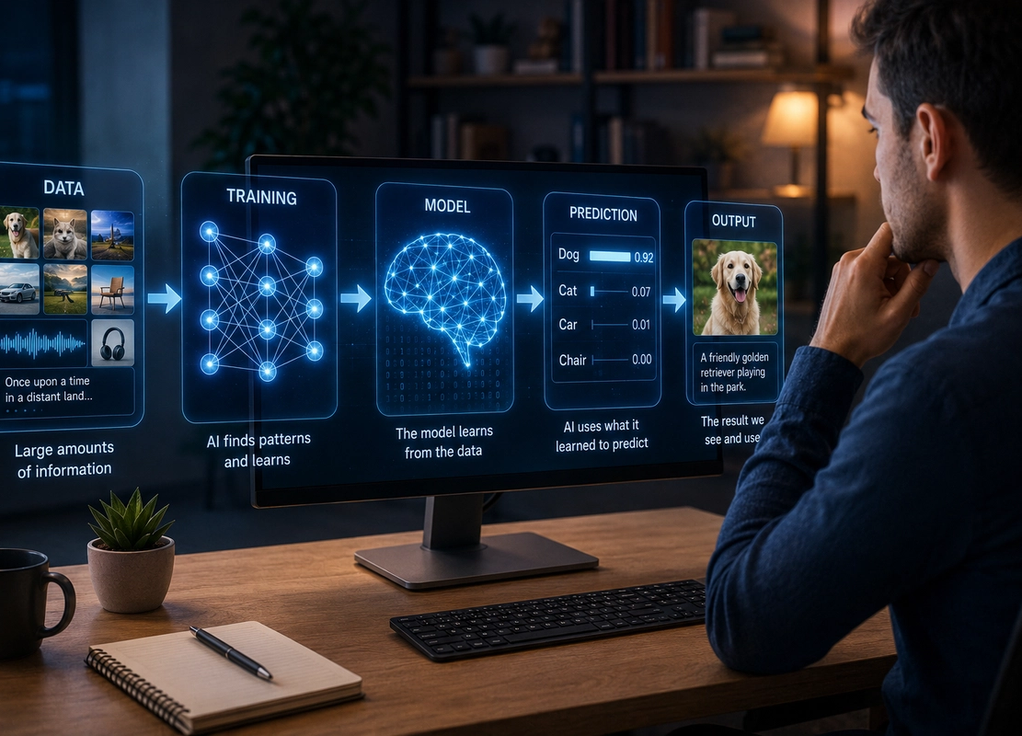
AI learns from examples, identifies patterns and uses what it has learned to produce an output.
AI learns from examples
Traditional computer programs are often built around explicit instructions.
Imagine creating a simple program that decides whether someone can enter a ride based on height. A programmer could write a rule saying that anyone below a particular height cannot enter.
The computer does not need to learn anything. It simply follows the rule.
Many AI systems work differently.
Instead of writing every possible rule, developers provide large amounts of training data and allow the system to identify useful patterns.
Suppose you wanted an AI system to distinguish photographs of cats from photographs of dogs. Rather than trying to describe every possible difference between every cat and dog, you could train the system using many labeled examples.
Over time, the system adjusts itself based on patterns in those examples.
It does not memorize a simple rule such as “cats have pointy ears,” because plenty of dogs have pointy ears too. It learns much more complicated combinations of visual patterns that help it make a prediction.
Training is where the learning happens
The process of teaching an AI model is called training.
At the beginning, the model may be terrible at its task. It makes predictions, compares them with the correct answers and adjusts its internal parameters to improve.
Imagine practicing basketball shots.
You take a shot, see that it went too far to the left and adjust your next attempt. After enough practice, your movements become better calibrated.
AI training is obviously very different from human practice, but the basic feedback idea is useful.
The system repeatedly makes predictions, measures how wrong they are and adjusts.
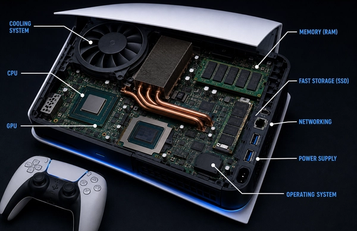
For modern AI models, this process can happen across enormous datasets using powerful computing hardware.
Eventually, the model develops an extremely complicated internal representation of patterns found in its training data.
Training can take substantial time and computing power. Once the model has been trained, however, people can use it to process new information it has never encountered in exactly the same form before.
Neural networks are pattern-finding systems
Many modern AI systems use structures called neural networks.
The name is inspired loosely by biological brains, but artificial neural networks are not miniature copies of human brains.
A neural network contains layers of interconnected mathematical units. Information enters the network, passes through those layers and is transformed along the way until the system produces an output.
You do not need to understand the mathematics to understand the important part.
Different parts of the network become sensitive to different patterns.
In an image-recognition system, early layers might respond to simple visual features such as edges or shapes. Later layers can combine simpler information into increasingly complicated patterns.
With enough training, the network can become extremely good at recognizing relationships that would be difficult for programmers to describe manually.
This ability is one reason AI has become useful for images, speech, language and many other complicated forms of information.
Generative AI predicts what should come next
Generative AI systems create new content rather than simply classifying existing information.
Large language models, including systems used for AI chatbots, are trained on enormous amounts of text. During training, they learn patterns in how words and ideas relate to one another.
When generating text, the model repeatedly predicts what should come next based on the context it has received.
This sounds simple, but the patterns learned by a very large model can be extraordinarily sophisticated.
If you write, “The capital of France is,” the likely continuation is obvious.
But language models can also continue complicated arguments, explain concepts, write code, summarize information and imitate different writing structures because training has exposed them to enormous numbers of relationships within language.
They are not retrieving a prewritten answer for every question.
They generate responses piece by piece based on learned patterns and the information available in the conversation.
AI does not understand exactly like a person
This is where conversations about AI become tricky.
Modern AI can produce behavior that looks remarkably intelligent. It can explain a difficult concept, analyze a document or write a convincing story.
But that does not mean it experiences those tasks the way a human does.
An AI system does not necessarily have personal experiences, intentions or common sense simply because its sentences sound human.
It can also confidently produce incorrect information.
This happens partly because generating a plausible response and verifying that every statement is true are different tasks.
A language model may produce something that fits the patterns it has learned even when the underlying claim is wrong.
That is why important AI-generated information should still be checked, particularly in areas such as medicine, law, finance or current events.
Fluent does not automatically mean correct.
Different AI systems are built for different jobs
“AI” is an extremely broad term.
The system recommending a song is not necessarily working exactly like the system generating an image. Software detecting suspicious banking transactions has a very different purpose from a chatbot.
Some AI systems classify information. Others predict numbers, recommend products, recognize speech, generate content or control physical machines.
Increasingly, systems can also work with several kinds of information at once.
A multimodal AI model might process text and images, for example, allowing someone to upload a photograph and ask questions about what it contains.
The underlying techniques can overlap, but there is no single machine or algorithm called AI.
It is better to think of artificial intelligence as a collection of technologies used to perform tasks that require sophisticated pattern recognition, prediction or decision-making.
AI improves through data, computing and better methods
The rapid improvement of AI did not happen because computers suddenly became conscious.
Several developments came together.
Researchers developed better training methods and model architectures. Vast amounts of digital data became available. Computing hardware became powerful enough to train much larger models.
Scale turned out to matter enormously.
When some AI models are trained with more data, more computing power and more parameters, they can develop capabilities that smaller systems struggle to reproduce.
This is one reason modern AI can feel dramatically different from the voice assistants and chatbots people used only a few years ago.
The basic concepts did not necessarily appear overnight.
The systems became much more capable.
AI is powerful because prediction can do more than it sounds
Describing AI as pattern recognition and prediction can make it sound unimpressive.
But prediction is involved in an astonishing number of useful tasks.
Recognizing an object means predicting what the image represents. Translating a sentence means predicting an appropriate version in another language. Generating text involves predicting how language should continue.
When these predictions become sufficiently sophisticated, the resulting behavior can look remarkably intelligent.
That does not make AI magic.
It makes it a technology built from enormous amounts of computation, data and human research.
You give the system information. It processes that information using patterns learned during training and produces the output it predicts is appropriate.
The mathematics underneath can be extremely complicated.
The basic idea does not have to be.